Why Success Starts Breaking Down When Your Role Changed but Your Title Did Not
Executive Takeaway
Success often starts breaking down when a role changes before the organization updates the title, authority, measurements, or compensation attached to it. You may still be capable and productive, yet find that the methods that once created confidence no longer work. Situational intelligence helps you distinguish underperformance from role drift, identify the job the business is actually asking you to do, and define the operating agreement required for success.
In This Article
- Why jobs change before titles do
- How to recognize role drift and an outdated job definition
- Why strong performers can feel as though they are failing
- How to distinguish a performance problem from role ambiguity
- Why the old scorecard stops working
- Which questions reveal the role you are actually performing
- What happens when compensation is the symptom rather than the first problem
- How to realign mandate, authority, measurements, title, and compensation
- How the 15-Minute Pre-Meeting Playbook supports the conversation
- Frequently asked questions about changing roles and responsibilities
Executive Summary
- What this article addresses: The experience of succeeding in a role that gradually expands until the title, expectations, authority, measurements, and compensation no longer reflect the actual job.
- What is often happening: Reorganization, leadership departure, growth, ownership change, or financial pressure has quietly altered what the organization needs from the position.
- Why this matters: When the role change remains unnamed, capable professionals often try to solve a structural problem by working harder, proving more, or treating the situation as a private crisis of confidence.
- What situational intelligence helps you do: Identify what changed, determine how success is now being judged, and separate a true performance gap from a role-definition gap.
- What to do next: Clarify the actual mandate, establish authority and support, define a new scorecard, change the communication relationship, and then address title and compensation from a stronger position.
Are you underperforming, or are you still working from an outdated definition of the job while the business is judging a new one?
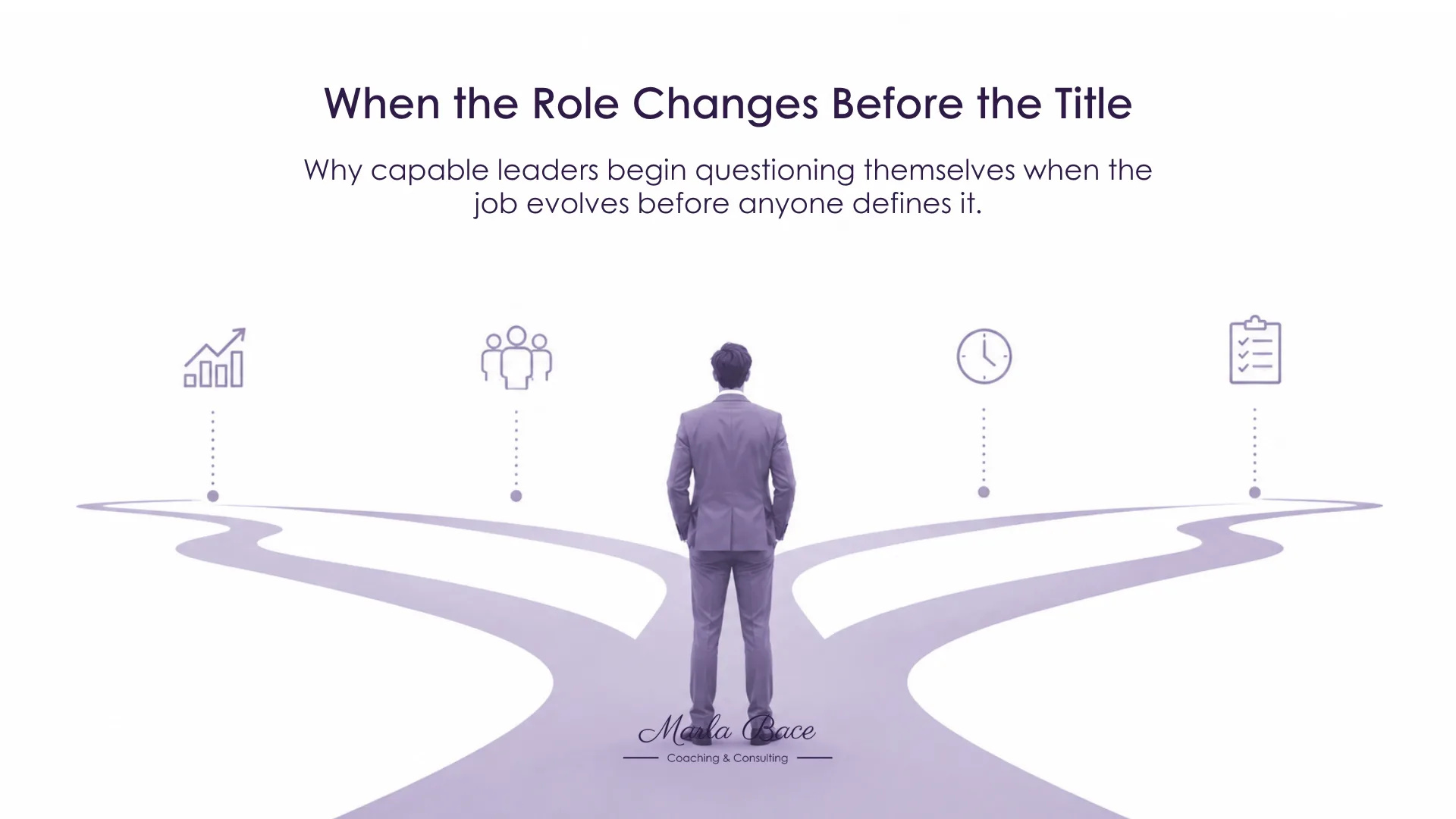
One of the most common reasons a role changes but a title does not is gradual organisational change. Success often starts breaking down when your role changes before anyone changes the title, expectations, authority, measurements, or compensation attached to it. You keep working harder inside the job you were hired to do while the organization quietly begins judging you against a different one.
For capable professionals, this can feel like an abrupt loss of confidence without an obvious cause. You were effective, you understood what success required. and you knew how to prioritize, communicate, and make decisions. Then the organization changed around you. People left. Teams were combined. Reporting lines shifted. New financial pressure emerged. Responsibilities that once belonged to several people accumulated around your position.
You adapted because that is what strong performers do.
But over time, the work stopped feeling coherent. Your title no longer described your actual responsibilities. Decisions carried more risk, but your authority remained unclear. Your manager expected broader leadership yet continued communicating with you as though the original role still existed. Your compensation began to feel disconnected from the value, complexity, and accountability you were carrying.
That experience is often interpreted as burnout, dissatisfaction, a confidence problem, or a difficult relationship with a boss. Any of those may be present. But sometimes the real problem is simpler and more consequential:
The role changed, and nobody named the change.
This is where situational intelligence becomes essential. Situational intelligence is the ability to recognize when the meaning of your role, relationships, authority, and performance has shifted, then respond to the position that actually exists rather than the one still printed in the job description.
Why Does a Job Change Before the Title Changes?
Jobs rarely change through one clean announcement.
More often, they change through accumulation.
A colleague leaves, and you absorb part of the work. Reorganization removes a layer of management. A growing company needs someone to build processes that never existed. An owner begins expecting a department leader to operate across the entire business. A private equity investor introduces new reporting requirements. A manager delegates broader decisions without explicitly transferring authority. A senior leader becomes responsible for profitability, talent, systems, customer retention, and cross-functional execution even though the title still reflects only one function.
Each individual change may appear manageable. Together, they create a different job.
The organization may not acknowledge the shift because no single person intentionally redesigned the position. The role evolved in response to pressure. Everyone adjusted incrementally, and the new expectations became normal before anyone stopped to define them.
This is especially common for senior managers, directors, vice presidents, and entrepreneurs. These professionals are often rewarded for adaptability, ownership, and initiative. Because they are capable, the organization continues placing more weight on them.
Their success can hide the structural problem.
The better they compensate for missing roles, unclear ownership, and shifting expectations, the easier it becomes for everyone else to assume the arrangement is working.
Signs Your Role Changed but Your Title Did Not
When your role changed but your title did not, the signs usually appear gradually. Role drift can be difficult to identify because it often resembles normal professional growth. Greater responsibility is not inherently a problem. The issue is whether the role’s definition, authority, support, and measures have grown with it. I often see capable leaders assume the discomfort means they need to become more confident, when the more important question is whether they are still being asked to succeed inside a role that no longer exists.
Common signs include:
- You are accountable for outcomes you do not fully control.
- Your decisions affect functions beyond the one named in your title.
- You are expected to solve problems that previously went to a more senior leader.
- Your manager increasingly relies on your judgment but has not clarified decision authority.
- You are measured on business outcomes rather than the functional work you originally owned.
- You spend more time aligning stakeholders than completing the work associated with your formal role.
- You inherited responsibilities after departures or reorganizations that were never formally reassigned.
- You are expected to create systems, processes, or teams rather than merely operate existing ones.
- Your compensation still reflects the earlier job.
- You feel increasingly dissatisfied even though you remain capable and productive.
The most important clue is often this: the work has become difficult to explain in one sentence. Your title no longer fits what you do, and compensation may feel misaligned because the organization is still valuing the earlier role.
When someone asks what you do, you may start with the official title and then spend several minutes describing the actual responsibility. That gap is not merely a communication issue. It may be evidence that the organization is operating with an outdated map of your position.
Why a Role Changed but Title Did Not Can Feel Like Failure
When your role changed but your title did not, your previous success strategies often stop working. Strong performers often assume that if success feels harder, they need to improve their performance.
They work longer hours.
Responsiveness increases.
Additional tasks land on their plate.
They begin anticipating every request.
Problems get solved before anyone else notices them.
Eventually, they become the person holding the entire operation together.
But the work may still feel less successful because the old methods no longer match the new role.
A functional leader who once succeeded through expertise may now need to succeed through delegation, systems, and cross-functional influence. A director who once delivered completed recommendations may now need to involve their leader earlier in the decision process. A vice president who once focused on revenue may now be expected to manage profitability, organizational risk, talent development, and portfolio-wide priorities. An entrepreneur who built the business through direct involvement may now need to operate as an owner rather than the most experienced employee.
The capability did not disappear. The success mechanism changed.
Without that distinction, capable people often conclude:
- I have lost my edge.
- My manager no longer trusts me.
- I am not as strategic as I thought.
- I cannot keep up with the role.
- I am being taken advantage of.
- I need a new job.
- I should be earning more, but I cannot explain why.
- I am doing everything and still not succeeding.
Some of those conclusions may eventually prove true. But they should not be the starting diagnosis.
The first question is: What job am I actually doing now?
Has Your Role Changed or Is It Really a Performance Problem?
Before assuming poor performance, ask whether your role changed but your title did not. A performance problem means the role is reasonably clear, but the expected results or behaviors are not being delivered consistently.
A role-ambiguity problem means the work, expectations, authority, or scorecard has changed without being translated into a coherent operating agreement.
A performance problem may include:
- missed commitments
- recurring execution errors
- weak follow-through
- avoidable stakeholder surprises
- poor prioritization inside a defined mandate
- failure to address known expectations
- resistance to reasonable accountability
A role-definition problem often looks different:
- competing priorities with no agreed hierarchy
- accountability without corresponding authority
- growing responsibility without updated measurements
- disagreement about what the role should own
- a title that reflects only one part of the actual work
- constant escalation because decision rights are unclear
- a manager expecting broader leadership without changing the communication relationship
- compensation concerns that are difficult to separate from the larger question of role scope
The two problems can coexist. A person may need to improve how they operate while also working inside a badly defined position.
Situational intelligence prevents you from collapsing both issues into the same conclusion. It helps you ask not only, “How can I perform better?” but also, “What performance is now being requested, and is the organization structured to support it?”
Why Your Scorecard Changes When Your Role Changes
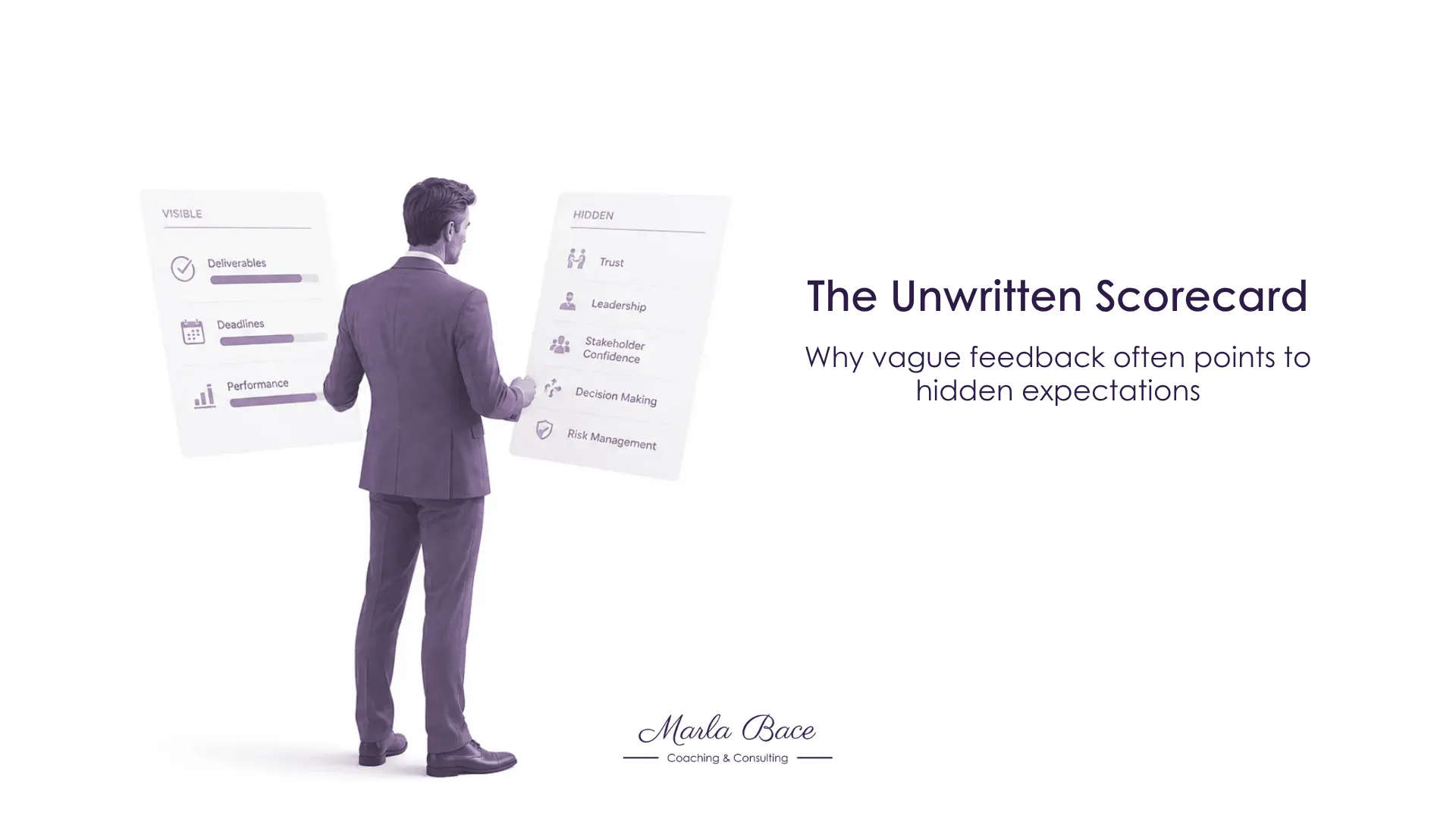
Every role has a scorecard, whether the organization writes it down or not.
In a clearly defined role, you usually understand what produces confidence. You may be measured on revenue, project delivery, customer retention, team performance, operational efficiency, quality, or functional expertise.
When the role expands, those measures may no longer be sufficient.
A sales leader may still be measured on revenue while being informally held responsible for margin, operational capacity, team structure, customer concentration, and leadership across multiple businesses. A director may still be evaluated on departmental performance while being expected to influence enterprise decisions. An entrepreneur may continue tracking growth while the real need has shifted to delegation, cash discipline, organizational design, or leadership succession.
The old scorecard becomes incomplete.
This creates a dangerous pattern: you continue producing the results that once defined success, while your manager becomes increasingly concerned about dimensions that were never clearly added to the role.
You believe you are delivering.
Your manager believes something is missing.
Neither person has named the new scorecard.
That is why role drift often becomes a confidence problem on both sides. The individual feels unseen or undervalued. The manager feels uncertain about whether the person can carry the broader responsibility. Both may be reacting rationally to an operating agreement that no longer exists.
Questions to Ask When Your Role Changed but Your Title Did Not
These questions help determine whether your role changed but your title did not, or whether expectations simply evolved. The fastest way to diagnose role drift is to compare the original role with the work that now consumes your judgment, attention, and accountability.
1. What responsibilities have accumulated that were not part of the original role?
Look at the work added after reorganizations, departures, growth, acquisitions, ownership changes, or leadership transitions. Do not focus only on tasks. Identify new categories of accountability.
2. What outcomes are you now expected to influence or own?
Are you being judged on profitability, talent, systems, customer experience, culture, strategic execution, or cross-functional alignment even though those outcomes are not reflected in the formal position?
3. What decisions are you making now that you did not make before?
Decision scope often reveals role scope more accurately than a job description. Consider budget, staffing, priorities, customer commitments, operational tradeoffs, risk, and resource allocation.
4. Where are you accountable without having clear authority?
If you own the outcome but must repeatedly negotiate permission, resources, or cooperation, the role may have changed without the authority structure changing with it.
5. What does your manager now need from you that they did not need before?
The new role may require earlier visibility, more enterprise framing, clearer recommendations, stronger delegation, financial fluency, or greater communication around risks and tradeoffs.
6. What should stop being part of your job?
A changed role cannot be defined only by adding responsibility. Some work must be delegated, transferred, redesigned, or discontinued. Otherwise, you are not operating in a new role. You are performing two jobs simultaneously.
7. How should success now be measured?
Until the new role has a meaningful scorecard, both you and your manager will rely on impressions. That is where frustration, overwork, and compensation conflict grow.
What Happens When a Senior Leader Has Quietly Moved into a Different Job?
A senior leader had been successful in an established position through multiple reorganizations, leadership departures, and business changes. With each transition, more responsibility accumulated. Because the leader was experienced and dependable, they continued absorbing the work. By the time we spoke, a weekly operating review that once focused on one function had expanded to include margin, staffing, vendor decisions, and customer risk.
Over time, the position became fundamentally different.
The leader was no longer responsible only for the function reflected in the title. They were making broader operational decisions, managing new forms of risk, shaping systems, navigating cross-functional priorities, and carrying expectations that had once belonged elsewhere in the organization.
Neither the leader nor the person they reported to had fully acknowledged that the job had changed. The leader knew something was misaligned but could not yet name the source of it.
When we first spoke, the clearest concern was compensation. The leader felt that pay no longer reflected the level of responsibility they were carrying. That concern was valid, but compensation was not the first problem to solve. What I noticed was that every example they offered to support a raise was also evidence that the organization had quietly created a different job.
The organization could not properly value a role it had not clearly defined. The leader also could not make a strong case for alignment while still describing the position through the expectations of the old job. The compensation issue was real, but it was the visible symptom of an unnamed structural shift.
The first step was to name what had changed.
We separated the original responsibilities from the new mandate. We identified the broader outcomes the leader was now expected to influence, where authority remained unclear, and which parts of the old role could no longer remain the primary focus.
The leader needed to stop measuring success only through the priorities that had defined the original position and begin looking at the business more broadly. That meant identifying the small number of financial, operational, and performance measures that now mattered most, understanding what those measures revealed, and being prepared to answer the questions a manager would reasonably ask of someone carrying wider responsibility.
Together, we clarified the three to five indicators that should guide the leader’s attention, how those indicators connected to overall business performance, and how to communicate what was working, what required intervention, and where tradeoffs needed to be made.
The leader also began framing recommendations through the broader needs of the business rather than only through the original function. As that shift became visible, the manager gained greater confidence that the leader could manage the operation at the level now required and contribute effectively as additional responsibilities were integrated into the portfolio.
Only then could compensation be addressed in the right context: not as a reaction to workload or frustration, but as part of aligning the role’s scope, accountability, and value.
Today, both parties have greater confidence. The leader is no longer trying to prove success using an outdated definition of the job. The manager has clearer evidence that the right person is operating in the expanded role.
The problem became workable because it was finally named.
That is situational intelligence in practice. It is not simply recognizing that you are overwhelmed or underpaid. It is seeing that the operating situation has changed, understanding what the new role now requires, and identifying what must be redefined before performance can be judged fairly.
Why Did an Outside Strategic Perspective Make Such a Difference?
The leader was too close to the situation to see the full pattern. They could feel the misalignment, but the most visible symptom was compensation. From inside the role, it was difficult to separate increased workload from a fundamentally different mandate, or to see how the manager’s questions reflected a new level of business responsibility rather than simple dissatisfaction.
That is where an outside strategic perspective changed the path.
Diagnosing the Situation, Not the Person
My role was not to help the leader make a stronger argument for being paid more or to offer generic advice about confidence, communication, or executive presence. I do not start with a model and force the situation into it. I read what is already happening in the role, the relationship, and the business, then connect the pieces that have not yet been named: the expanded mandate, the changed measures of success, the manager’s expectations, the leader’s operating habits, and the organization’s evolving needs.
Using 30 years of real-world executive and organizational experience, along with claircognizant pattern recognition, I could see that the compensation concern was part of a larger structural issue. The leader did not simply need better language for a difficult conversation. They needed a new understanding of the position they were already occupying and a practical way to operate in it deliberately.
Testing Assumptions Before Taking Action
Strategic coaching provided a place to test assumptions before acting on them. We could distinguish what the leader knew from what they were inferring, identify which measures genuinely mattered, anticipate the manager’s questions, and prepare for conversations that built confidence rather than defensiveness. Each step was connected to the actual business situation, not to a generic model of what a leader at that level should look like.
That outside perspective also protected the leader from approaching the compensation conversation too early. Had they led only with workload, fairness, or frustration, the organization might have responded to the request without ever addressing the undefined role beneath it. By naming the new mandate first, the leader could demonstrate how the position had changed, how they were adapting to it, and what alignment now required.
The Difference Strategic Situational Intelligence Makes
The result was larger than a better compensation discussion. The leader gained a more grounded understanding of the business, a clearer way to operate, and stronger confidence in the value they were creating. The manager gained greater confidence that the leader could carry the expanded responsibility. The organization gained a more useful definition of the role it had already created.
That is the difference between generic coaching and strategic situational intelligence. The work does not begin by trying to change the person. It begins by diagnosing the environment, the role, and the relationship so the person can respond to the situation that actually exists.
What to Do When Your Role Changed but Your Title Did Not
The strongest response is not to begin with a demand for a new title or compensation adjustment. Those may be appropriate outcomes, but they are difficult to resolve until the actual role has been made visible.
1. Document the role changes without turning it into a task inventory
A long list of everything you do can make you sound overworked without demonstrating that the level of responsibility has changed.
Group the work into categories such as:
- business outcomes
- decision authority
- organizational leadership
- financial responsibility
- stakeholder influence
- operational risk
- talent and team development
- systems or infrastructure
The objective is to show the changed altitude of the role, not the volume of your calendar.
2. Identify what the business now needs from the position
Frame the conversation around the organization, not only around fairness.
Ask:
- What business problem is this expanded role solving?
- What would be at risk if no one carried this responsibility?
- What outcomes should the position now own?
- What decisions must sit here for the business to operate effectively?
This makes the role easier to evaluate objectively.
3. Clarify authority, support, and escalation
Responsibility without authority creates chronic friction. Determine which decisions you can make, which require consultation, and which must be escalated.
4. Establish a new scorecard
Agree on a small number of measures that reflect the actual mandate. These may include financial results, operational performance, team capability, strategic execution, customer outcomes, or reduced organizational risk.
5. Change communication relationships
An expanded role often requires different communication with your manager.
You may need to move from reporting activity to framing decisions. Instead of giving a list of updates, communicate:
- what is happening
- what matters most
- what tradeoff is required
- what you recommend
- what decision or alignment you need
That shift makes broader leadership visible.
6. Address title and compensation after the role is defined
Compensation should reflect scope, accountability, complexity, and market value. But the conversation becomes stronger when the role, expected outcomes, and authority have already been named.
You are no longer arguing, “I am doing too much.”
You are demonstrating, “This is the position the organization now needs, this is the value it carries, and this is how it should be structured.”
Why Is Naming the New Role More Important Than Proving You Can Handle It?
Many strong professionals believe the organization will eventually recognize the role if they perform it well enough.
Sometimes it does.
Often, strong performance simply normalizes the expanded responsibility.
The organization becomes accustomed to receiving a higher level of leadership without formally redefining the position. The individual continues absorbing ambiguity. Resentment grows. Compensation becomes symbolic of a larger lack of acknowledgment. Eventually, the person either disengages, leaves, or begins underperforming because the structure is no longer sustainable.
Naming the role interrupts that cycle.
It gives the individual and manager a shared language for discussing:
- what changed
- what the organization now requires
- what success looks like
- what decisions belong in the role
- what support is needed
- what work should move elsewhere
- how the position should be measured
- how title and compensation should align
Correctly naming the problem is not an exercise in semantics. It changes what both parties can do next.
How to Lead When Your Role Changed but Your Title Did Not
The real leadership move is to stop treating the experience as a private crisis of confidence and start diagnosing the operating reality.
Your dissatisfaction may not mean you are ungrateful.
It could simply mean something important is missing.
Feeling stretched does not necessarily mean you have become less capable.
Nor does your manager’s uncertainty automatically mean they have lost faith in you.
The organization may be asking the position to carry something fundamentally different without giving either of you the language to understand it.
Situational intelligence helps you see the difference.
It allows you to step back from immediate frustration and ask:
- What changed?
- What is the business now asking this role to accomplish?
- What version of the job is my manager evaluating?
- What version am I still performing?
- What needs to be redefined before we can judge success fairly?
The answer may lead to a new operating agreement, a redesigned role, different measurements, stronger communication, updated authority, compensation alignment, or a decision that the position is no longer right for you.
But you cannot make that decision well while the real job remains unnamed.
What Should You Do When Your Role No Longer Matches the Job?
If your role changed but your title did not, the 15-Minute Pre-Meeting Playbook helps you prepare for a role-definition conversation by clarifying the outcome you need, the evidence that makes the changed responsibility visible, the pressures shaping your manager’s view, and the smallest useful next step.
Download the 15-Minute Pre-Meeting Playbook to prepare for a conversation about mandate, authority, measurements, title, or compensation.
When the role has become too complex to diagnose from inside it, book a Strategic Leadership Conversation. I bring 30 years of real-world executive and organizational experience, along with claircognizant pattern recognition, to identify the connections, contradictions, and hidden dynamics shaping the position and determine what needs to be named before the role can be aligned.
Frequently Asked Questions
Professional growth usually expands capability within a reasonably coherent role. Role drift occurs when responsibilities, outcomes, decision authority, or organizational expectations change significantly without corresponding changes to the role’s definition, support, measurements, title, or compensation.
Begin by documenting how the level and category of responsibility changed, not simply how much work was added. Clarify the outcomes you now own, the decisions you make, and the business value of the expanded role. Then discuss role structure, authority, measurements, title, and compensation as connected issues.
Frame the conversation around changed business needs. You might say, “The role has expanded across several areas, and I think it would help both of us to clarify the outcomes I should own, how success should be measured, and which decisions should sit with me.”
Your confidence may have dropped because the role’s success criteria changed. You may still be capable, but you are operating without a clear mandate, scorecard, authority structure, or communication agreement. Confidence often improves after the new situation is accurately defined.
First establish the actual scope of the role, the business outcomes it owns, and how it differs from the position originally defined. Compensation discussions are stronger when they are based on responsibility, accountability, complexity, and market value rather than workload alone.