Second-guessing is one of the most misunderstood experiences in leadership.
Many capable leaders assume it signals something has gone wrong. They interpret hesitation as loss of confidence, weakening judgment, or the early stages of imposter syndrome.
In reality, the opposite is often true.
Second-guessing often arises when leaders operate in environments where signals become more complex, making interpretation essential for effective decision-making.
What once felt like straightforward decision-making now carries additional weight.
The leader has not become less capable.
Leaders who understand that the environment has become harder to interpret can feel more confident in their ability to navigate ambiguity.
Understanding this distinction matters because many leaders respond to second-guessing by trying to eliminate it. They push themselves to act faster, appear more certain, or suppress doubt altogether.
Ironically, that response often produces poorer decisions.
Second-guessing is not something to fear or eliminate. It signals that leaders are operating at a level where interpretation is crucial for growth.
For many leaders, second-guessing is not evidence of weakness. It is evidence that they have reached a level of responsibility where interpretation matters as much as action.
Why Do Leaders Start Second-Guessing Their Decisions?
One of the most common questions leaders search for is simple:
Why do leaders second-guess themselves?
At early career stages, decision signals are relatively clean. The variables are narrower. Feedback arrives quickly. The consequences are usually contained.
As responsibility grows, the signal environment changes.
A single decision may affect multiple teams, external partners, or long-term strategy. Feedback becomes less direct. Information may be filtered through several layers of communication before reaching the decision-maker.
Under those conditions, even experienced leaders begin to revisit their thinking.
A decision that felt clear at the moment may feel less certain hours later when additional perspectives emerge.
A piece of feedback may trigger reflection about whether the original interpretation was correct.
This does not necessarily mean the decision was wrong.
It means the decision occurred within a system whose signals are evolving.
Capable leaders begin to notice these shifts precisely because their judgment has become more refined, inspiring confidence in their evolving interpretation skills.
The leader who never second-guesses anything is not necessarily decisive. They may simply be ignoring signals that deserve attention.
Why Do Senior Leaders Doubt Decisions That Once Felt Clear?
Many senior leaders describe a surprising moment in their careers.
Earlier in their trajectory, decisions felt faster and easier. With experience, they expected that clarity would increase.
Instead, they sometimes find themselves questioning decisions more frequently.
This phenomenon often leads leaders to ask whether they are experiencing imposter syndrome at a higher level.
In some cases, that may be true.
But more often, the explanation is structural.
As leadership responsibility increases, the nature of feedback changes.
Early feedback is direct. A project succeeds or fails. A manager provides explicit input. A client responds immediately to results.
Senior leadership feedback is different. Signals arrive indirectly. Outcomes unfold slowly. The connection between action and consequence becomes less visible.
Under those conditions, leaders may find themselves revisiting their reasoning because the environment provides fewer immediate confirmations.
Research from Harvard Business School examining decision-making under uncertainty highlights a similar dynamic. As complexity increases, experienced leaders often engage in more deliberate reflection because the cost of misinterpretation rises.
That reflection can feel like doubt.
In reality, it is often the mind that adjusts to a more ambiguous signal environment.
Why Does Responsibility Make Leadership Signals Harder to Read?
Responsibility does more than increase workload.
It changes how information moves through an organization.
At higher levels of responsibility, leaders rarely interact with raw information. Instead, they are interpreting signals shaped by communication filters, organizational incentives, and political dynamics. Think of the game of telephone from your youth.
A peer’s comment may reflect several underlying concerns or layers of information. Agreement in a meeting may be polite rather than indicative of alignment. Silence may signal hesitation, disagreement, or simple information overload.
These signals require interpretation.
And interpretation takes time.
Many capable leaders experience second-guessing precisely because they begin recognizing how layered those signals have become.
Earlier in their careers, they may have interpreted a situation more quickly because the variables were clearer, less complex, or less weighty.
Now the same leader may pause, revisit assumptions, or consider multiple explanations before acting.
That pause can feel uncomfortable.
Yet it often reflects deeper situational awareness rather than declining confidence.
Is Imposter Syndrome Always the Cause of Leadership Self-Doubt?
Search results about leadership doubt often point directly to imposter syndrome. Research shows that many high-achieving professionals experience impostor syndrome, in which they believe others overestimate their abilities despite clear evidence of competence.
While imposter syndrome can affect leaders at any level, it does not explain every instance of second-guessing.
Understanding the difference between psychological doubt and situational ambiguity helps leaders interpret their second-guessing more accurately, fostering better self-awareness.
Psychological doubt occurs when a leader internally questions their competence despite evidence of capability.
Situational ambiguity occurs when the information environment surrounding a decision is genuinely unclear.
In complex organizations, the second situation appears frequently.
A leader may question whether their interpretation of an event is accurate, not because they lack confidence, but because the signals themselves are mixed.
Consider a common leadership moment.
A strategy decision is made after several weeks of discussion. The leader leaves the meeting feeling confident in the direction. Later that day, a senior colleague makes an offhand comment that appears supportive but slightly ambiguous.
The leader begins replaying the earlier discussion.
Was the agreement genuine?
Was something left unresolved?
Did the colleague interpret the decision differently?
These questions can feel like self-doubt. In reality, they are attempts to clarify interpretation.
The leader is not questioning their capability. They are questioning whether they correctly understood the environment.
That distinction matters because the response should be different.
Psychological doubt requires internal confidence-building. Situational ambiguity requires additional signal clarification.
Why Do Capable Leaders Revisit Decisions After They Are Made?
Another search question appears frequently among senior professionals:
Why do leaders doubt decisions after making them?
This experience often occurs because leadership decisions rarely end at the moment they are announced.
Once a decision enters the organization, new signals begin to appear.
Team responses. Operational constraints. Informal feedback from peers. Questions that reveal interpretations the leader did not anticipate.
Each of these signals may cause the leader to revisit the original reasoning.
The key distinction is whether the leader revisits the decision productively or becomes trapped in circular doubt.
Productive reconsideration asks:
What new information has emerged?
What assumptions were challenged?
Does the new signal change the direction, or does it require better communication?
Circular doubt asks:
Did I make the wrong decision?
What if I missed something?
What if this reflects a weakness in my judgment?
The first set of questions improves decision-making in leadership.
The second set often creates unnecessary internal pressure.
Learning to distinguish between those two patterns is one of the most important leadership skills at higher levels of responsibility.
How Do Experienced Leaders Manage Second-Guessing Without Losing Momentum?
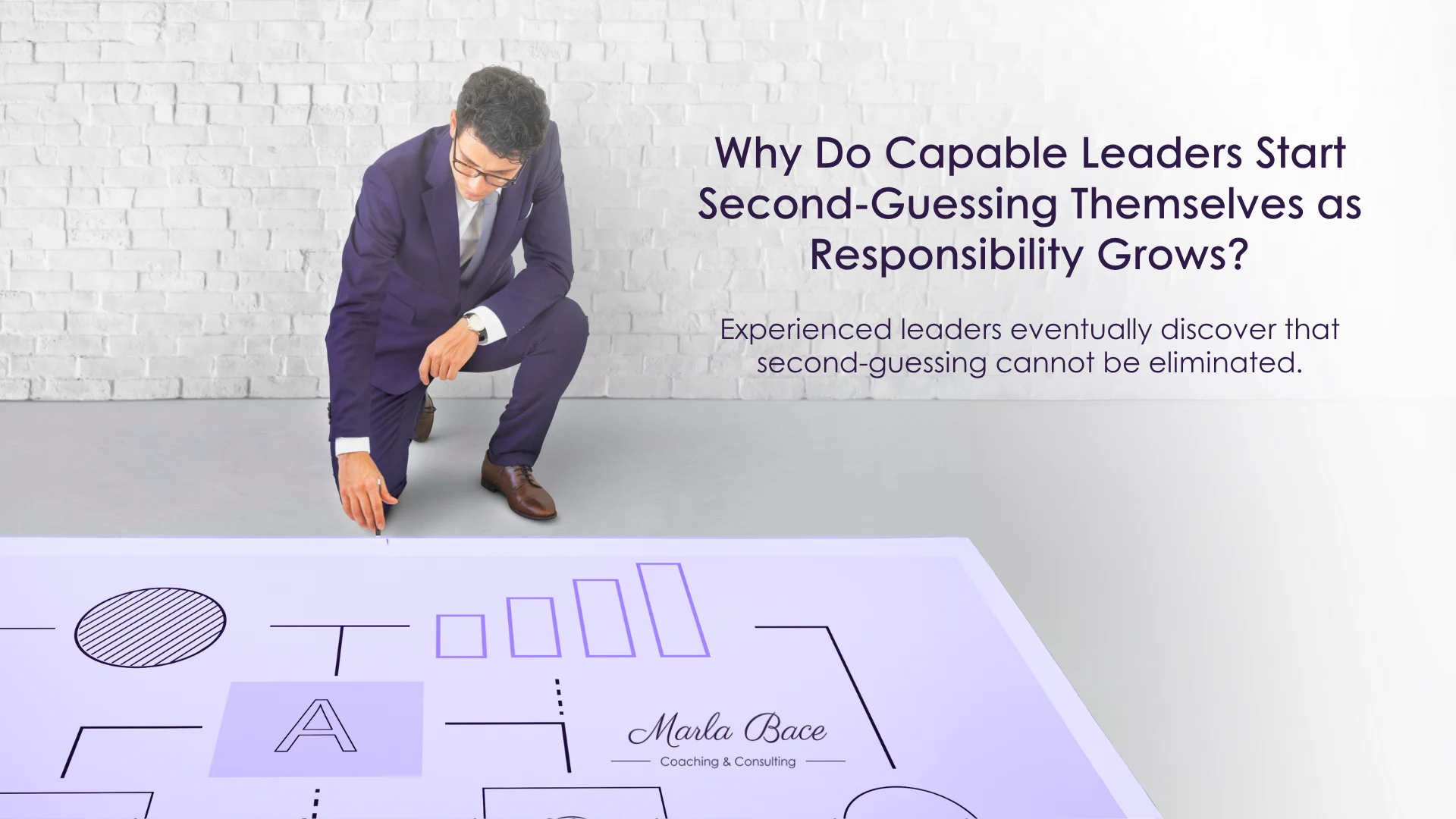
Experienced leaders eventually discover that second-guessing cannot be eliminated.
Instead, it must be managed.
The most effective leaders develop a simple discipline.
They separate the interpretation phase from the action phase.
During interpretation, they allow themselves to examine signals carefully. They revisit assumptions, consider alternative explanations, and ensure that the situation has been understood correctly.
Once interpretation is complete, they shift to action.
The key is not allowing the interpretation phase to continue indefinitely.
A leader who never pauses risks acting on incorrect signals. A leader who never exits interpretation risks paralysis.
Strong leadership judgment lies between those two extremes.
It allows enough reflection to interpret signals accurately while maintaining the momentum necessary for progress.
What Should Leaders Do When Second-Guessing Appears?
When second-guessing appears, many leaders attempt to silence it immediately.
A more productive response is curiosity.
Second-guessing can be treated as a question rather than a threat.
What signal triggered this reaction?
Is the doubt coming from internal insecurity or external ambiguity?
Has new information emerged, or is the mind replaying the same signals repeatedly?
These questions often reveal that second-guessing points to something worth examining.
Perhaps the leader sensed misalignment in a meeting that deserves follow-up. Perhaps the feedback they received contained a subtle signal that requires clarification.
Or perhaps nothing new has appeared, and the doubt is simply the mind reacting to the increased weight of responsibility.
Distinguishing between those possibilities helps leaders respond proportionately.
Not every signal deserves a change in direction.
But every signal deserves accurate interpretation.
What is the Real Skill Leaders Develop as Responsibility Grows?
Leadership development is often described as learning to make faster or more confident decisions.
In reality, the deeper skill leaders develop is interpretation.
They learn to read their environments more carefully.
They learn that signals rarely mean exactly what they appear to mean at first glance.
They recognize when hesitation reflects useful reflection rather than weakness.
And they develop the discipline to move forward once interpretation is complete.
Second-guessing does not disappear as responsibility grows.
But its meaning changes.
For capable leaders, it becomes less a sign of insecurity and more a signal that the environment deserves closer attention.
When leaders understand that distinction, second-guessing stops being an obstacle.
It becomes part of the judgment process itself.
If this topic resonates, I share deeper reflections on leadership judgment and decision-making in my monthly newsletter.
If this reflection was useful, feel free to forward it to someone navigating similar leadership challenges.
Second-guessing rarely means something is wrong.
More often, it signals that there’s more to interpret than before.
In Presence is Power, I explore the patterns shaping leadership judgment beneath the surface—so you can read situations more accurately, not just decide faster.
Frequently Asked Questions About Leaders Second-Guessing Their Decisions
Leaders often second-guess themselves as responsibility increases and decision-making environments become more complex. Signals are less direct, feedback is delayed, and outcomes are harder to interpret, which requires deeper analysis rather than faster action.
Not always. While imposter syndrome can cause internal self-doubt, many cases of second-guessing come from situational ambiguity—where the information available is genuinely unclear or incomplete.
At senior levels, decisions impact more stakeholders, feedback loops are slower, and information is filtered through multiple layers. This makes signals harder to interpret and increases the need for deliberate judgment.
Effective leaders separate interpretation from action. They allow time to assess signals and assumptions, but once clarity is reached, they commit to action without revisiting decisions unnecessarily.