A toxic workplace culture can have a profound impact on individuals. We don’t lose ourselves in toxic environments all at once. We erode.
Not because we’re weak, but because over time, culture can convince even the most capable people that silence is safer than truth, and endurance is the same as resilience.
I’ve seen two types of responses to draining environments:
There are those who boldly reclaim their agency, and those who unintentionally abandon it. The former, a testament to the power of choice, inspires us to take control of our narrative.
Neither reaction is about intelligence or value. It’s about what happens when culture starts making choices for you.
This is a story of both.
The Client Who Stepped Out — and Stepped Back Into Herself
She didn’t leave because it was easy. She left because staying was costing too much.
Her workplace had become a slow, steady drain. Not explosive. Not dramatic. Just the kind of environment that chips away at your voice, your confidence, and your energy until your body knows before your mind does: this is no longer safe to grow in.
And she listened. Not to panic, not to perfection, but to alignment.
She stepped out without a shiny plan, but with a clear decision:
I won’t keep abandoning myself to survive a culture I didn’t create.
She didn’t just throw herself into activity, she made intentional choices. Not hustle theater. Not desperation. But a sense of empowerment through alignment.
She didn’t just redirect her energy, she redirected her destiny. The same energy she once spent enduring that environment, she now invests in creating her next one. A journey of liberation and hope.
Today, she’s in momentum. Four and five interviews a week. Third and fourth-round conversations. Not scrambling — aligning. And the difference shows. She isn’t chasing any job. She’s clearing space for the right one.
That’s what leadership resilience looks like when it’s self-directed.
The Client Who’s Still Inside — and Doesn’t See It
Her story is different.
Not because she’s less capable. Not because she’s less intelligent.
But because she’s resigned — and she doesn’t recognize it as a resignation.
Her language tells the story before she does:
“I’m not getting clear direction.”
“They won’t let us … (fill in the blank).”
“Our sprints are six weeks.”
“It was disappointing when I got here, but I’m going to keep trying.”
Every statement sounds like an observation. But it’s depletion in disguise.
She believes she’s still fighting, but what she’s really doing is circling:
- Naming the problem without changing her proximity to it
- Waiting for leadership to see her instead of reclaiming visibility
- Hoping culture shifts without requiring her to
- Mistaking exhaustion for loyalty
And when the advice isn’t acted on — or acted on halfway — it becomes easier to decide whether someone or something else is the problem. Often, the person is trying to help.
Months ago, I suggested therapy not because she’s broken, but because coaching can’t penetrate a belief system that’s already surrendered. Therapy becomes the bridge when someone’s agency is so buried that new strategies feel like personal attacks.
That’s not failure. That’s what happens when culture wins quietly.
The Difference Isn’t Skill — It’s Agency
Leadership resilience isn’t defined by how much you can tolerate.
It’s defined by how willing you are to choose differently when staying costs you your voice, your clarity, and your ability to decide what’s next.
Here’s what separated the two:
Client One: Energy Redirected
- She acknowledged the drain instead of normalizing it
- She stepped out before the culture could finish reshaping her
- She replaced survival mode with intentional movement
- She acted on guidance instead of analyzing it to death
Client Two: Energy Surrendered
- She internalized the disappointment as a personal limitation
- She stayed loyal to the dysfunction that silenced her
- She rehearsed the problem instead of experimenting with solutions
- She redirected blame inward when progress didn’t happen
Neither reaction is about competence.
It’s about choice — or the slow, quiet loss of it.
When Culture Silences You Without Forcing You Out
Workplace culture doesn’t always push people away. Sometimes it convinces them to stay — by wearing them down until they stop choosing.
I tell leaders this often:
It’s crucial for leaders to understand this:
Not choosing becomes a choice.
Silence becomes agreement.
Endurance becomes identity.
And that’s how culture “wins” — not through force, but through exhaustion.
A Quick Reality Check for Any Leader Still Inside the Wrong Room
Here are a few signs culture is making choices on your behalf:
- You spend more time explaining the problem than trying something different
- You wait for permission to lead in the role you were hired for
- You justify your exhaustion as proof of commitment
- You’ve stopped imagining alternatives because you’re convinced this is “better than nothing”
- You spend more energy tolerating than creating
If any of those feel familiar, it’s not a personal flaw — it’s a signal that something deeper is running the show.
Key Takeaway
Culture doesn’t break you when it’s loud — it breaks you when it’s familiar.
It convinces you that discomfort is noble, loyalty is silent, and trying harder inside the problem is the same as growth.
But the truth is simple:
- You cannot heal in the environment that is draining you.
- You cannot lead if you’ve stopped choosing.
- You cannot rise if you’ve made peace with shrinking.
One client reclaimed that truth.
The other hasn’t yet.
And this is the pivotal difference.
Final Reflection
Emotional intelligence isn’t just about understanding others — it’s about noticing when you’ve stopped acting on your own behalf. Leadership resilience isn’t measured in sacrifice. It’s measured in self-honoring choices.
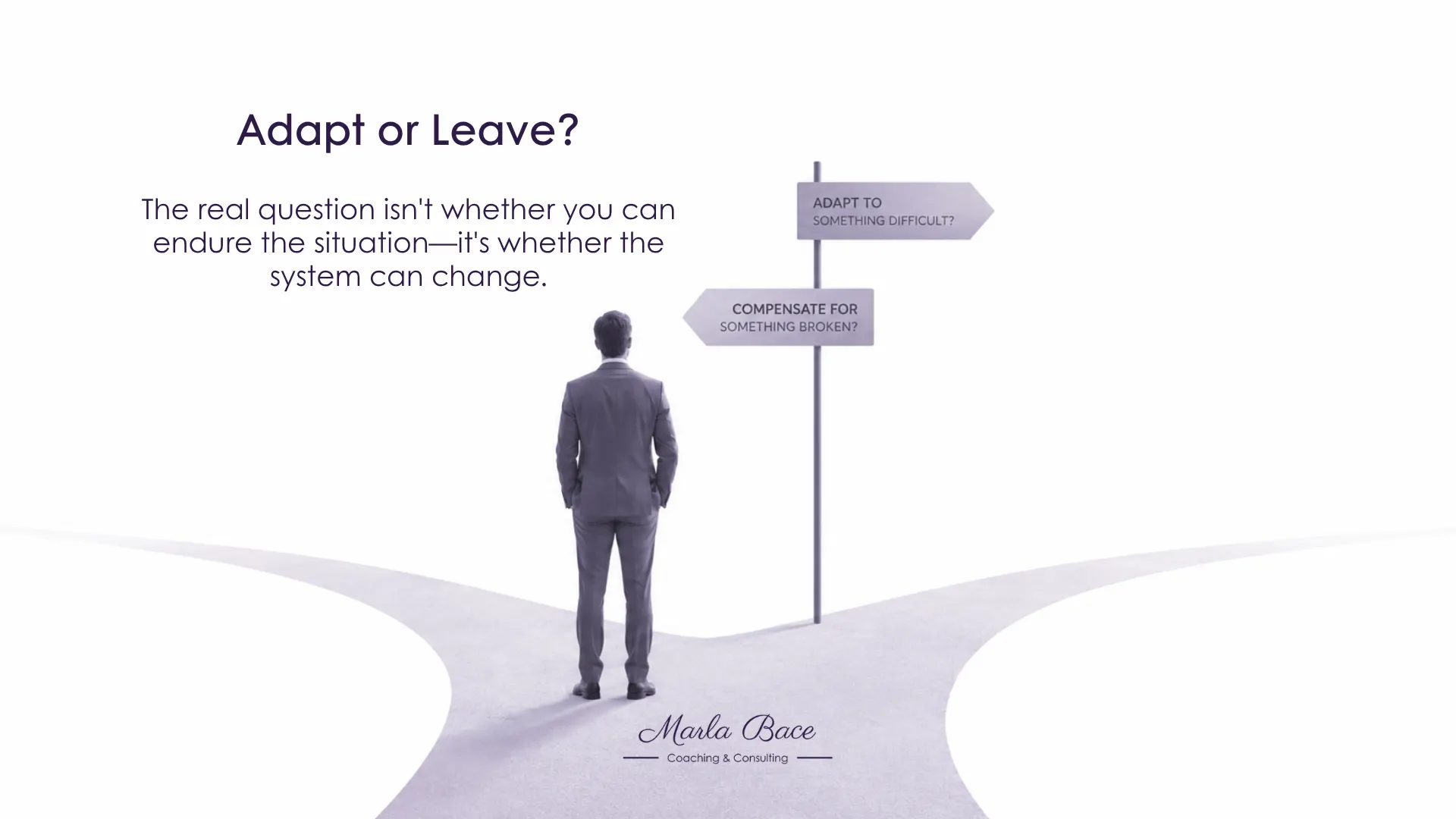
If you’ve been silently enduring a culture that doesn’t reflect who you are, the question isn’t “How do I survive it?”
It’s this:
“At what point do I stop letting it speak for me?”
Because the longer you stay muted, the harder it is to remember your voice.
✅ Want a deeper lens on this?
Here’s a powerful read on the cost of staying silent in a disengaging culture:
“The Hidden Toll of Workplace Resignation” – Harvard Business Review