Managing up with confidence is not about impressing your boss or agreeing with every decision. It is about understanding the priorities, pressures, and power dynamics influencing those above you so you can communicate strategically and effectively. Many senior managers struggle because they focus on authority rather than context. The leaders who manage up successfully learn how to align their message with organizational realities while maintaining their own credibility and judgment.
This question has been recurring in my conversations with professionals and leaders over the past few months. In fact, many people are seeking guidance on managing up with confidence. Not as a technical question, but as a lived one.
They’re being asked to prepare for promotion before the title arrives—
to operate in ambiguity,
to demonstrate executive presence without overstepping,
and to think strategically without unsettling the person they report to.
What they’re really asking is this: How do I speak with confidence when I don’t yet feel secure in my authority—and when the consequences of missteps are real?
The answer most people expect is confidence.
The answer that actually works is discernment. Wrapped in clarity, collaboration, and communication.
Managing up with confidence has far less to do with seniority or polish than with executive reasoning—the ability to assess what matters, identify the real decision, and communicate in a way that reduces risk rather than amplifies it.
Why “Be More Strategic” Often Creates More Anxiety Than Direction
Many high-performing professionals are told they need to “be more strategic” as they move toward senior leadership. The feedback is well-intentioned but rarely effectively defined.
What I see instead is people trying to sound strategic—expanding ideas, adding context, connecting the dots broadly—only to find their manager’s response becomes guarded or tense. Not because the thinking is wrong, but because this type of communication unintentionally shifts power dynamics.
Strategy without discernment can lead to recommendations that aren’t anchored in authority or timing.
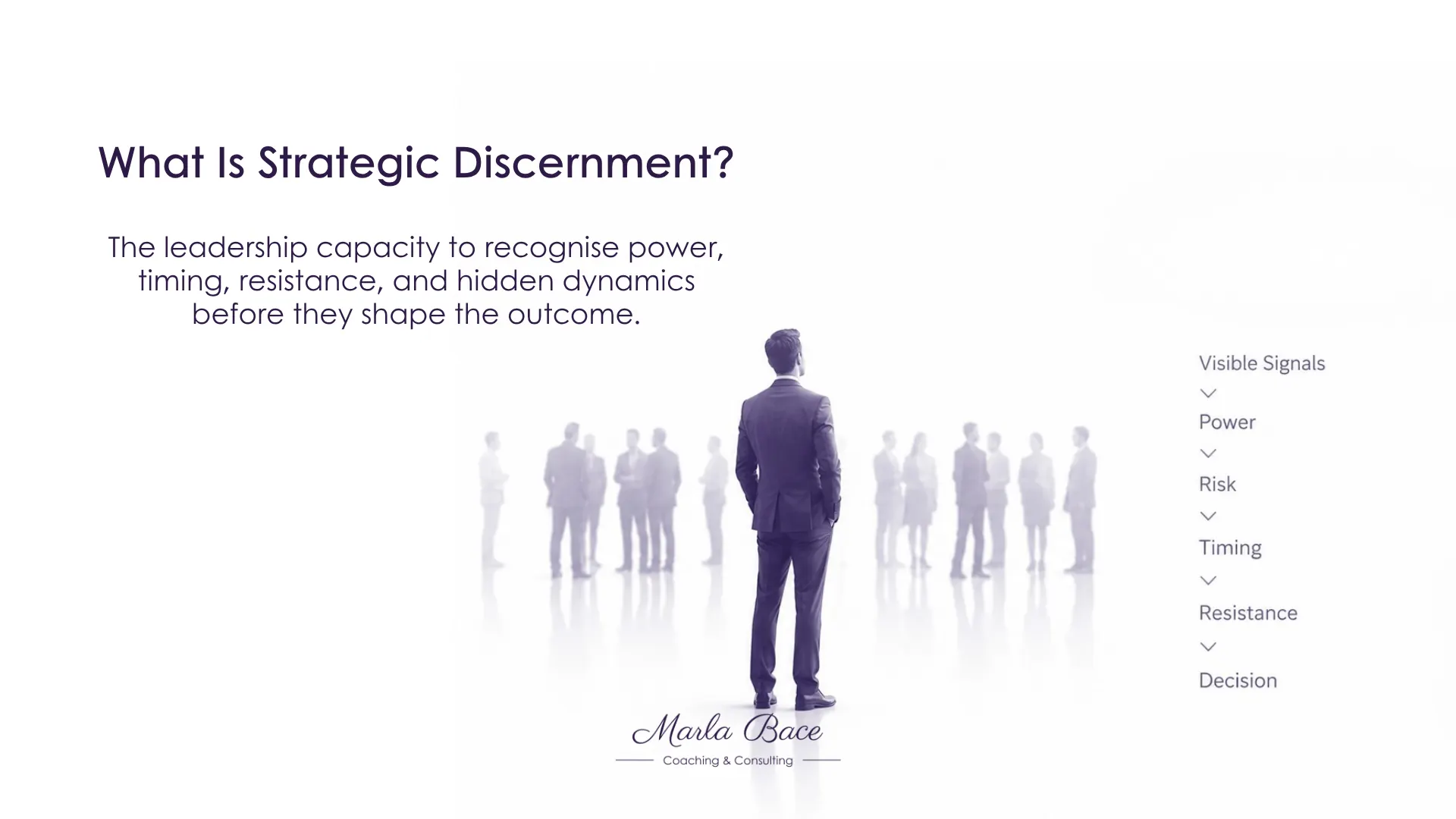
Senior stakeholders are not listening for how much you know. They’re listening to determine whether you understand where responsibility sits, what risks are involved, and what decision is actually being surfaced.
When that isn’t clear, even strong ideas can land poorly.
Managing Up With Confidence: The Reframe That Changes Everything
Confidence in managing up comes from clear asks, not seniority.
This is where many capable leaders get stuck. They believe confidence will come once they have more experience, authority, or certainty. In reality, confidence is built through disciplined communication, especially when certainty is unavailable.
Clear asks signal judgment.
Judgment lowers perceived risk.
Lower perceived risk builds trust.
This is not about being bold. It’s about being precise.
The Confidence Myth: “I Need More Experience Before I Speak Up”
This belief keeps talented people quiet at exactly the moment they’re being evaluated for readiness.
Experience matters but waiting to feel confident before contributing is a losing strategy. The leaders who grow fast are not the ones who speak most forcefully—they’re the ones who can think and speak in real time, without over-explaining or hiding behind analysis.
The leaders who do this well aren’t guessing. They’re drawing on discernment—having enough context, pattern recognition, and judgment to speak responsibly with roughly 80 percent of the information—wrapped in clarity, collaboration, and communication, without waiting for perfect certainty.
They’ve learned how to reason out loud.
That doesn’t mean narrating every thought. It means structuring communication so that others can quickly understand:
- what matters
- what’s at stake
- and what decision is being requested
Replacing Over-Explaining With Structured Communication
Over-explaining is usually a sign of care, not incompetence. People want to be thorough. They want to show they’ve considered multiple angles. But in senior-level conversations, quantity often increases uncertainty.
Structure does the opposite.
One of the most effective shifts I see is when leaders stop trying to prove they’ve thought deeply—and instead make their thinking usable.
A Mini-Framework for Managing Up With Executive Reasoning
This framework isn’t about templates for their own sake. It’s a thinking discipline.
- Context
What’s happening, and why does it matter now - Clear Conviction
What do you recommend and why - Compromise
The tradeoffs you’re managing - Call
The decision, alignment, or input you are calling for
This structure does something subtle but powerful. It shows respect for authority while demonstrating ownership of thinking. It keeps stakeholders engaged without overload, and allows senior stakeholders to engage without feeling cornered or overridden.
Why This Reduces Perceived Risk
Senior leaders are paid to manage risk—organizational, reputational, and political. When communication is diffuse, risk perception increases. When communication is disciplined, risk feels contained.
Clarity, in this context, isn’t about simplification. It’s about signal over noise. You demonstrate discernment.
When leaders communicate this way, they’re no longer asking to be seen as confident. They’re demonstrating it through how they reason, prioritize, and engage.
Confidence becomes communicative precision, not bravado.
Managing Up Is Not a Performance—It’s a Practice
Managing up well requires awareness of timing, authority, and human dynamics. It requires knowing when to expand thinking and when to narrow it. When to push and when to pause.
It’s not about claiming a role before you have it. It’s about showing you understand the role—before anyone has to explain it to you.
This is where leadership presence actually lives. Not in posture or polish, but in judgment exercised under pressure.
This is where leadership presence actually lives. Not in posture or polish, but in judgment exercised under pressure—relying on discernment, context, pattern recognition, and experience to speak responsibly with roughly 80 percent of the information, grounded in clarity, collaboration, and communication rather than waiting for perfect certainty.
If these questions resonate, I explore them more deeply each month inside my community. Join my monthly newsletter to receive reflections on leadership presence, executive reasoning, and the inner work required to lead well when certainty is scarce and responsibility is real.
You can also explore this theme further in my post on leadership presence.
If managing up feels more complicated than it should, the issue may not be confidence or communication skills alone.
A Clarity Review helps uncover the organizational dynamics, stakeholder expectations, and hidden factors shaping your influence so you can lead more effectively from exactly where you are.
The Clarity Review was designed for these kinds of leadership challenges.
A short, focused session to help you see what’s yours to carry—and what isn’t.
Frequently Asked Questions
Managing up means building a productive working relationship with your manager by understanding their priorities, communication style, challenges, and expectations. The goal is to improve alignment, decision-making, and mutual trust.
As leaders become more senior, the stakes increase and organizational dynamics become more complex. Managing up often requires influencing decisions without direct authority while navigating competing priorities and political realities.
Effective managing up is not about manipulation or office politics. It involves providing valuable insight, anticipating challenges, communicating clearly, and helping decision-makers make informed choices.
Power dynamics influence how messages are received, who has influence, and which perspectives carry weight. Understanding these dynamics helps leaders communicate more strategically and avoid unnecessary resistance.
The most effective approach is to focus on outcomes, risks, and organizational impact rather than personal opinions. Leaders who present thoughtful alternatives while demonstrating an understanding of broader priorities are often viewed as more credible, not less.