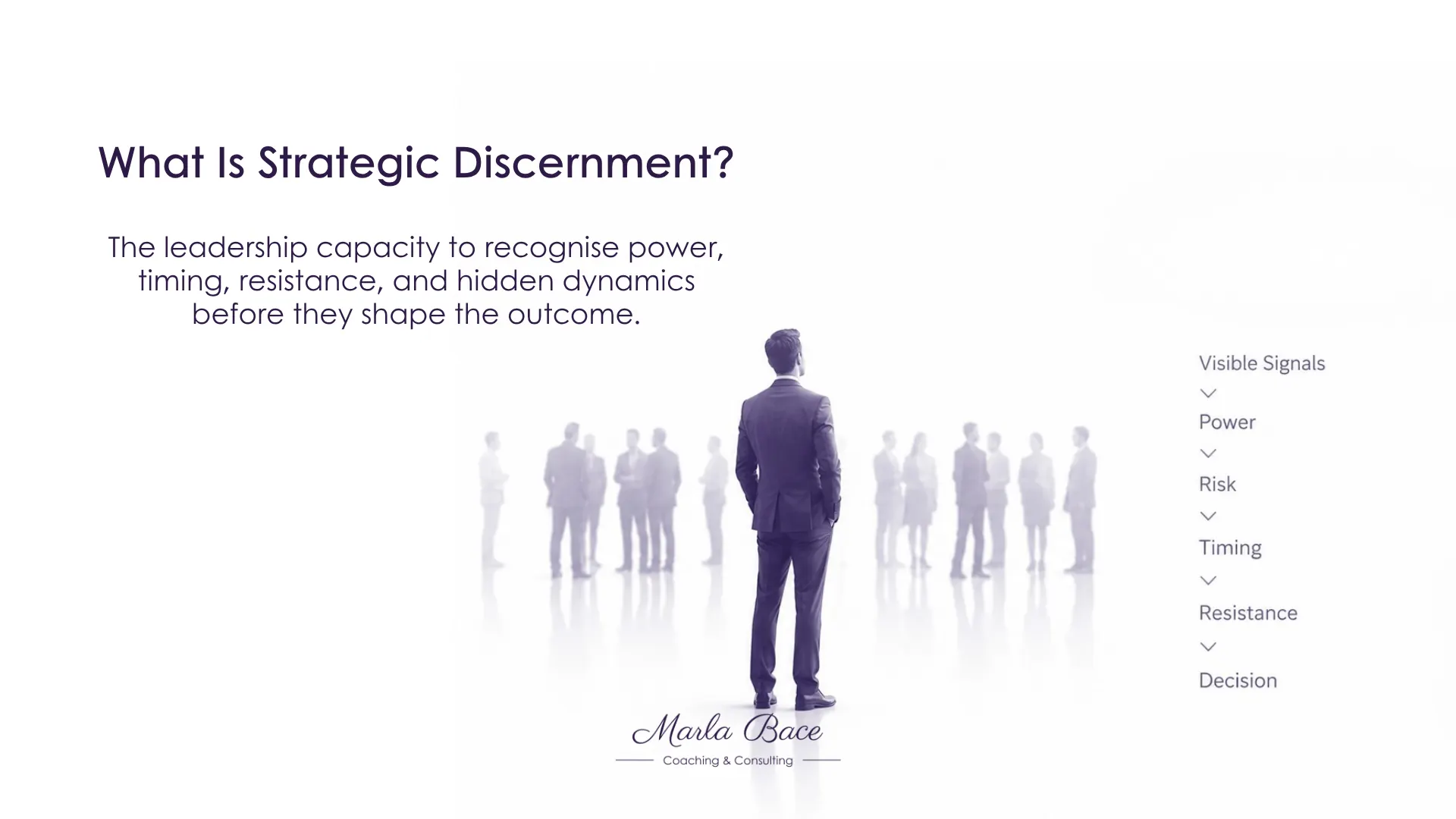
Influence without authority comes from understanding what drives decisions, trust, and credibility inside an organization. Most capable leaders assume influence grows naturally from expertise and strong performance. In reality, influence is often determined by how well you read stakeholder priorities, navigate power dynamics, and communicate in ways that align with what matters to others. The challenge is rarely a lack of capability—it is understanding how influence actually works within the system you are operating in.
Leading effectively when authority and decision rights don’t align
Once leaders recognize that micromanagement often signals misaligned authority rather than a lack of trust, the next question becomes more difficult.
What do you actually do with that information?
This is where many capable leaders get stuck. They can name the dynamic. They understand the system. But the path forward feels narrow. Push too hard, and you risk being labeled political, difficult, or threatening. Pull back, and your influence continues to erode.
A quiet internal negotiation follows: How much do I assert? Where do I adapt? When should my thinking be visible? And how carefully should I move?
This tension is not a failure of confidence. The reality of leading within authority is not yet fully settled.
What Influence Without Authority Really Means
In systems where authority and decision rights don’t align, force can feel like the only lever. Escalate. Insist. Prove expertise more aggressively.
Influence without authority relies on credibility, not pressure
Research on leadership influence without formal authority shows that effective leaders rely on communication, relationships, and credible judgment to inspire followership even when hierarchical power is limited.
At senior levels, this approach almost always backfires.
Why escalation triggers resistance in senior systems
Influence gained through pressure can make others feel undervalued, so focusing on trust helps your team feel respected and understood.
What leaders are actually evaluating: judgment, timing, restraint
Most leaders are not evaluating how certain you sound. They are assessing judgment, timing, and restraint. When influence is claimed rather than demonstrated, authority becomes something to defend against.
This is why many experienced leaders feel trapped between speaking up and staying quiet. Neither extreme restores real influence.
Why Influence Without Authority Matters for Senior Leaders
One of the most counterintuitive shifts capable leaders make is learning to reduce noise rather than add it.
Influence without authority increases when you reduce noise
When authority is unclear, expanding context often increases anxiety. More explanation, more justification, more data can unintentionally amplify risk for those who remain accountable for the outcome.
How to narrow conversations: decisions, tradeoffs, urgency
Influence begins to return when leaders intentionally narrow conversations by helping others make decisions, making tradeoffs explicit, and distinguishing urgent issues from those that can wait.
Building Influence Without Authority Through Strategic Discernment
It is about making judgment easier to engage with.
Leaders regain influence when their communication stabilizes the environment, helping others feel secure and trust in the process.
Stabilize the environment by making decisions feel safer
Leaders regain influence when their communication stabilizes the environment by making judgments visible in a way that respects authority boundaries without overstepping.
There is a difference between asserting authority and signaling readiness for it.
Capable leaders regain influence when their thinking becomes legible in a way that respects where authority currently sits, without surrendering ownership of the work.
What “legible thinking” looks like in practice
This often shows up through small but meaningful shifts in how decisions are communicated:
- Framing recommendations around shared risk rather than personal preference
- Naming uncertainty without retreating from a point of view
- Clarifying where responsibility is being held, not just what should be done
These moves do not demand authority. They demonstrate the capacity to carry it.
Over time, this changes how others engage. Control begins to loosen, not because it was requested, but because it feels safer to release.
Stabilizing authority before trying to expand it
Authority is rarely granted all at once. It stabilizes incrementally.
Authority stabilizes incrementally, not through announcements
Leaders who regain influence understand this and work within it. They do not try to win every decision. They focus on making the decision-making process itself more coherent.
Decision rights expand when others feel less exposed
When others feel less exposed to how you think and communicate, understand that you are dealing with risk, not how, they begin to rely on you differently. Influence grows quietly. Decision rights expand without formal announcements.
This is the difference between leadership that is tolerated and leadership that is trusted.
The leadership shift that endures
Regaining influence in misaligned systems does not require power plays, escalation, or self-erasure. It requires coherence.
Coherence is the alternative to escalation or self-erasure
Capable leaders do not create authority. They earn it by reducing uncertainty, clarifying decisions, and exercising judgment under pressure in a way others can follow.
When authority is misaligned, the work is not to fight the system or disappear inside it. It is to stabilize it from your current position.
This is the leadership work that determines who is eventually given latitude and who remains constrained, regardless of title.
A quiet invitation to go deeper
I explore these leadership dynamics regularly in my newsletter, where the focus is not on performance tactics, but on the deeper work of influence, judgment, and presence in complex organizational environments.
If this reflection resonates, I invite you to join the conversation by subscribing.
If you know you have valuable insights but struggle to gain traction, support, or influence within your organization, a Clarity Review can help identify what is really happening.
Together, we explore stakeholder dynamics, hidden barriers, and the contextual factors shaping your influence so you can lead more effectively without relying on authority alone.
The Clarity Review was designed for exactly this type of leadership challenge.
A short, focused session to help you see what’s yours to carry—and what isn’t.
Frequently Asked Questions
Influence without authority is the ability to shape decisions, gain support, and drive outcomes without having direct control over people or resources. It relies on credibility, relationships, trust, and strategic communication rather than positional power.
Many leaders assume expertise and strong results should automatically create influence. However, influence often depends on understanding stakeholder motivations, organizational dynamics, and how decisions are actually made.
Influence does not require manipulation or office politics. Effective leaders focus on understanding priorities, building trust, communicating strategically, and helping others achieve shared objectives.
Power dynamics shape who gets heard, whose opinions carry weight, and how decisions are made. Leaders who understand these dynamics can position ideas more effectively and avoid unnecessary resistance.
Common signs include repeatedly having good ideas ignored, struggling to gain stakeholder support, being excluded from key conversations, or finding that strong performance is not translating into broader organizational impact.