Executive Takeaway
Reading what is really happening in a room is not a personality trait, a body-language trick, or a vague instinct. At senior level, it is a leadership capacity built through situational intelligence and strategic discernment: the ability to track what is being said, what is being avoided, and what has already been decided before the meeting formally begins. The leaders who develop this capacity stop reacting to the surface conversation and begin leading from the actual dynamics shaping the outcome.
In This Article
- What reading the room actually means at senior level
- Who this article is really for
- Why this skill is not body language, empathy, or generic social awareness
- The three layers of any professional room: stated agenda, real concerns, and pre-decisions
- The signals most professionals miss and why they miss them
- How situational intelligence helps leaders read power, timing, resistance, and readiness
- How to develop the capacity without becoming paranoid or over-analytical
- What changes when a leader can read accurately and move with precision
- How Marla’s advisory lens helps leaders hear the room underneath the story
- How the 15-minute playbook and 30-minute strategy session support a more accurate read
- Frequently asked questions about reading the room, situational awareness, and strategic discernment
Executive Summary
- What this article addresses: The leadership capacity to read what is actually happening in complex professional rooms, especially when the stated agenda does not match the real dynamic.
- What is often happening: A capable leader is listening to the content of the meeting while missing the power, timing, protection, avoidance, or pre-decision underneath it.
- Why this matters: At senior level, missing the real room can lead to wrong recommendations, stalled influence, misread resistance, wasted preparation, and strategic moves that are technically sound but badly timed.
- What situational intelligence helps you do: Read the environment, identify who shapes the decision, understand what is being protected, and see when the meeting is not the actual decision point.
- What strategic discernment adds: The ability to test the read, separate signal from projection, and choose the move that fits reality rather than the official explanation.
- What the accurate read restores: Less effort, more precision, better timing, cleaner communication, and the ability to bring the right thing to the right moment.
- What to do next: Learn to read beyond Layer 1 before assuming the problem is your communication, your confidence, or the quality of your idea.
How Do You Develop the Ability to Read What Is Really Happening in the Room?
Reading what is really happening in a room is a learnable skill, but it is not the skill most people think it is.
It is not about reading body language or about becoming more empathic. It is not about scanning the room for every micro-expression and turning yourself into a professional overthinker.
What it is about, is developing structured attention to three specific layers of any professional situation: what is being said, what is being avoided, and what has already been decided before the meeting began.
Most professionals are trained to listen to content. Senior leaders have to learn to listen to conditions.
That is the difference between hearing the meeting and reading the room. One tells you what people are saying. The other tells you what the room can actually do with what is being said.
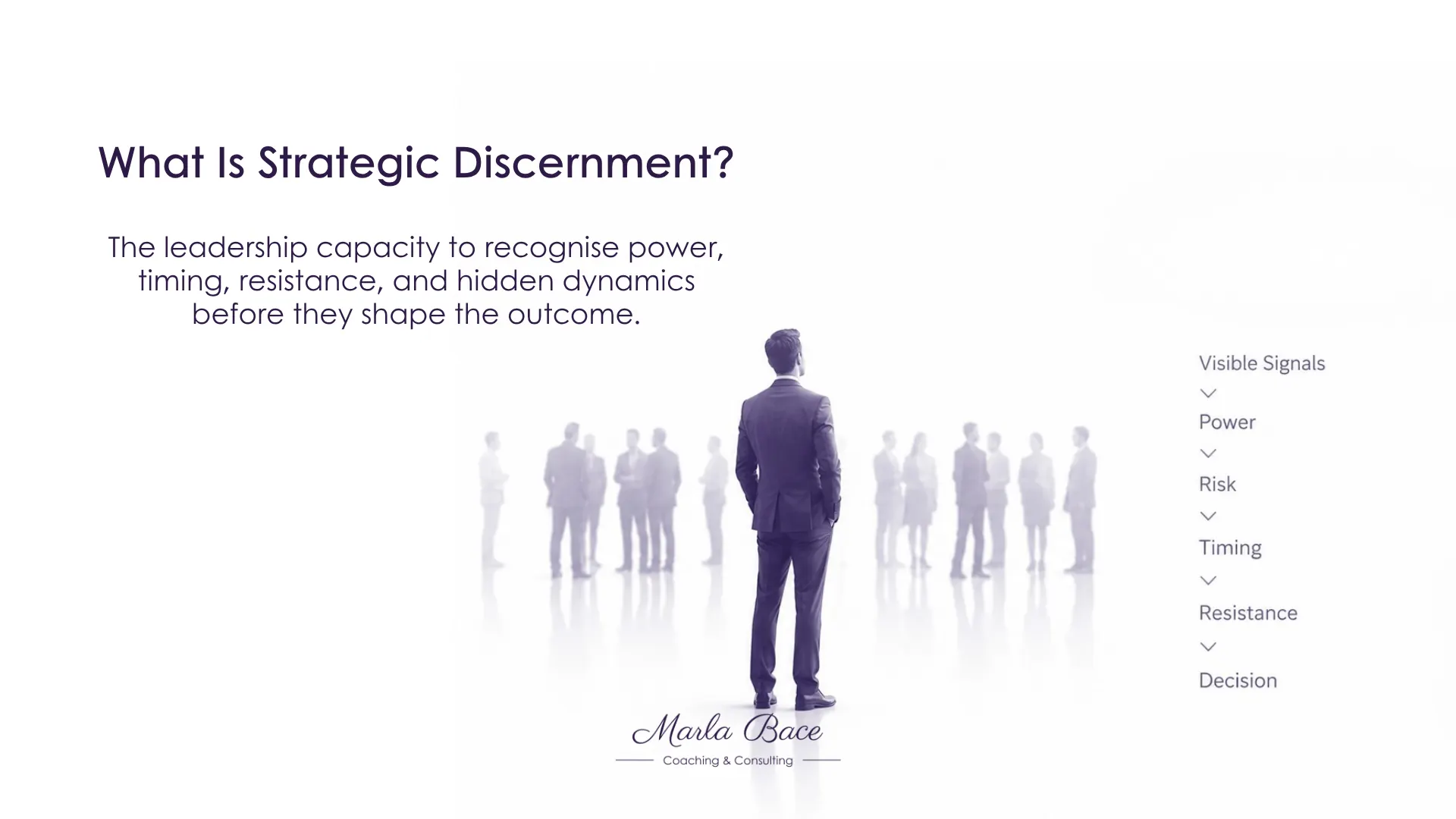
This is where situational intelligence and strategic discernment become practical. They help a leader stop treating every meeting as if the stated agenda is the whole truth. At senior level, it rarely is. The agenda is often the visible layer. The real work is happening underneath it: in the hesitation, the sequencing, the questions no one asks directly, the stakeholder whose silence changes the temperature, and the decision that is being managed rather than made.
If you cannot read that, you may bring the right recommendation to the wrong room. You may answer the stated question while missing the actual concern. You may assume resistance is about the idea when it is really about ownership, exposure, timing, or power.
Reading the room is not guessing. It is disciplined attention.
And the quality of that attention often determines whether a leader wastes energy on the stated conversation or moves the actual one.
Who Is This Article Really For?
This is not primarily for someone who wants to become more charismatic in meetings or appear more polished in front of senior leaders.
This is for the senior manager who knows something important is happening beneath the conversation but cannot yet name it quickly enough to use it.
It is for the director who leaves a meeting thinking, “I answered the question, but I missed the room.”
Also for the executive who can feel that a decision is being shaped somewhere other than the meeting they are sitting in.
It is for the high-capacity leader who is perceptive, thoughtful, and often right, but sometimes realizes too late that the room was never deciding what it claimed to be deciding.
And for the person who has been told they are intuitive, strategic, sensitive to dynamics, or good at seeing around corners, but has not yet learned how to turn that perception into a clean leadership move.
The buyer for this work is not looking for tricks. They are looking for a more accurate read. They do not need another generic framework telling them to speak up, build influence, or manage stakeholders and they need to know what the room is actually doing before they decide how to move inside it.
If you have ever known the conversation on the table was not the real conversation, this is the skill I am naming.
If you have ever left a meeting realizing you prepared for the topic but not for the actual dynamic, this is the skill I am naming.
What Does Reading the Room Actually Mean at Senior Level?
At junior and mid levels, reading the room is often treated as social awareness. Notice tone. Pay attention to reactions. Understand personalities. Adjust your communication so you do not miss obvious cues.
That still matters. But at senior level, reading the room becomes more consequential and more complex.
The room is no longer just a group of people. It is a system of authority, risk, incentives, history, pressure, reputation, and hidden constraint. The conversation may sound simple, but the conditions underneath it are rarely simple.
Reading the room at this level means understanding what kind of room you are in.
Is it a decision room, or a room where a decision already made elsewhere is being softened for public consumption? Or is it an alignment room, or a room where disagreement is being performed politely because no one wants to absorb the consequence? A strategy room, or a protection room? The stated issue really resources, or is the real issue trust? Is the debate about the idea, or about what the idea will rearrange?
These distinctions matter because each room requires a different move.
If you treat a protection room like a decision room, you will over-explain or if you treat a political delay like a data gap, you will build another deck. If you treat silence like agreement, you will mistake politeness for commitment and wonder later why nothing moved.
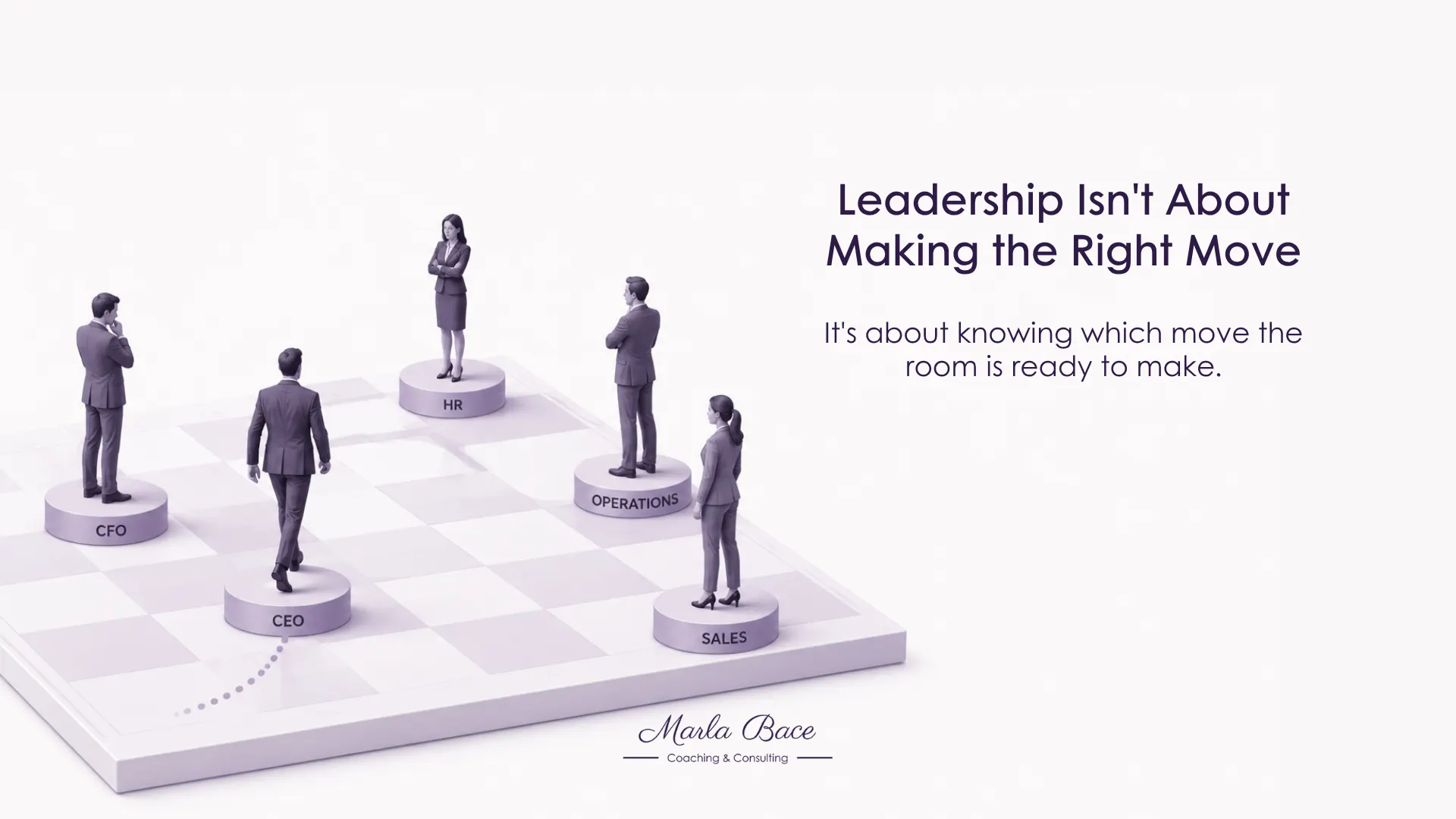
This is why reading the room becomes more critical the higher you go. Senior leadership is not only about having better answers. It is about knowing what reality the answer has to land inside.
Most people only read the transcript. Strategic leaders read the conditions that produced the transcript.
The leader who reads accurately does not just understand the conversation better. They understand what the conversation can and cannot produce.
What Are the Three Layers of What Is Actually Happening in Any Professional Room?
There are usually three layers operating in any consequential professional room. Most professionals only operate on the first one.
Layer 1: What Is Being Said
Layer 1 is the stated agenda. It is what appears on the calendar invite, in the deck, in the project update, or in the official question being asked.
This layer matters. You cannot ignore it. The stated agenda gives you the visible topic, the language the organization is willing to use, and the formal reason people are gathered.
But Layer 1 is rarely enough.
A meeting may say it is about budget. It may actually be about who has authority to decide. A discussion may say it is about timeline. It may actually be about who is afraid of being accountable if the decision creates disruption. A performance conversation may say it is about communication. It may actually be about discomfort with the leader’s level of visibility.
Layer 1 tells you the topic. It does not always tell you the truth.
Layer 2: What Is Being Avoided
Layer 2 is where the real concerns live. This is what people are managing, protecting, or avoiding saying directly.
It may be fear of a senior stakeholder or it may be a loss of control. Political exposure, anxiety about a decision that will reveal a prior mistake, resentment, fatigue, distrust, or the unspoken belief that the organization says it wants change but does not actually want the consequences of change.
Layer 2 often shows up indirectly. More questions. More process or softening, more “let’s circle back.” It might be more agreement in the room and less action afterward.
This is where many capable leaders lose time. They keep answering the stated concern while the actual concern remains untouched.
If the room is protecting something, information alone will not move it. You have to understand what is being protected before you decide whether to name it, reframe it, sequence it differently, or leave it alone until the room is ready.
Layer 3: What Has Already Been Decided
Layer 3 is the pre-decision. This is what has already been determined before the meeting began, even if the room is still acting as if the issue is open.
Sometimes the meeting is not where the decision is made. It is where the decision is socialized, defended, delayed, or managed.
You can usually feel this when the conversation has a strange quality. The questions are narrow. The options are technically open but emotionally closed. Certain alternatives are discussed politely but never seriously considered. The room keeps returning to one outcome no matter what evidence appears.
A leader who misses Layer 3 may keep trying to influence a decision that has already moved. A leader who reads Layer 3 can decide whether to challenge the pre-decision, influence the implementation, protect their position, or stop wasting energy where the outcome is no longer open.
That is not cynicism. It is situational intelligence. You cannot lead effectively if you do not know whether the room is deciding, pretending to decide, or managing a decision already made elsewhere.
Most wasted effort in senior rooms comes from solving Layer 1 problems when the real constraint is sitting in Layer 2 or Layer 3.
What Does This Look Like in a Real Leadership Moment?
A director walks into a meeting prepared to recommend a shift in resourcing. The stated agenda is prioritization. The data shows that one team is carrying too much complexity and another initiative needs to slow down.
Layer 1 is clear: review the work, make a decision, align on next steps.
But as the meeting unfolds, the director notices the conversation keeps circling away from one specific project. No one wants to say it should pause, even though every other part of the discussion points there. A senior leader praises the analysis, then asks whether the team can “find a way to keep everything moving.” Another person suggests a follow-up discussion with no clear decision owner.
A less discerning read says the room needs more clarity. Build another version of the resourcing model. Add more data. Make the recommendation sharper.
A more accurate read says the issue is not clarity. The issue is that pausing the project exposes a prior leadership commitment no one wants to publicly revise.
That changes the move. The director does not need to prove the analysis harder. They need to name the consequence the room is avoiding in language the room can use: “It sounds like the question is no longer whether the resourcing pressure is real. It is whether we are willing to reset expectations on the initiative creating the pressure.”
That sentence reads the room. It does not attack anyone or perform politics. It simply moves the conversation from the stated agenda to the actual dynamic.
This is what strategic discernment looks like in practice. You bring the right truth to the right layer of the room.
The issue was never the quality of the recommendation. The issue was that the room was managing the exposure created by the recommendation, not evaluating the recommendation itself.
What Signals Do Most People Miss?
The signals are usually observable. They are just not always loud.
Most professionals miss them because they have been trained to pay attention to the wrong things: the deck, the agenda, the question being asked, the person with the title, the official process, the feedback as stated.
Senior-level reading requires noticing what does not match.
Repeated Requests for More Data That Do Not Change the Decision
Another data request can be a real data request. It can also be a polite way to delay ownership. The question is whether the new information would actually change the decision. If it would not, the room may not be seeking clarity. It may be buying time.
Agreement That Does Not Produce Movement
Agreement is not alignment. If everyone agrees in the meeting and nothing changes afterward, the room may have produced social harmony rather than commitment. That is a Layer 2 signal.
Questions That Are Smaller Than the Decision
When the room asks minor process questions around a major strategic issue, something else may be happening. The concern may not be the detail being discussed. It may be the consequence of the decision no one wants to own directly.
The Person Everyone Looks At Before Speaking
Formal authority and informal authority are not always the same. Watch whose reaction changes the room and watch who gets checked before the conversation moves. Watch who does not have to say much to shape the outcome.
The Topic That Keeps Getting Reframed
If the room keeps reframing the same issue as timing, then resources, then communication, then process, the stated explanation may not be the real constraint. The issue may be too uncomfortable to name in its original form.
Silence That Changes the Temperature
Silence is not always agreement. Sometimes it is calculation, resistance, fear, and sometimes it is a signal that the real decision-maker has not yet revealed their position.
These signals do not mean you should assume the worst. They mean you should slow down and test the read before you move.
The mistake is not failing to notice everything. It is failing to notice which mismatches between words and behavior are carrying the real information.
Why Do Smart Leaders Miss What Is Really Happening?
Smart leaders miss the room for very understandable reasons.
They are often over-focused on being prepared. They are trying to deliver the answer, manage the impression, protect the relationship, satisfy the ask, or move the work forward. Those are reasonable instincts. They are also the exact instincts that can keep a leader locked on Layer 1.
A capable leader may miss Layer 2 because they are trying not to be political. They do not want to overread people, assume motives, or become cynical. That integrity matters. But refusing to read power does not make power disappear. It only makes the leader less equipped to work with reality.
A capable leader may miss Layer 3 because they believe the meeting is the decision point. They assume that if the right people are in the room and the right information is on the table, the decision is still open. Sometimes it is. Sometimes the real decision has already moved through informal influence, private conversations, founder preference, board pressure, or risk avoidance.
This is not a lack of intelligence. It is trained attention. Most successful professionals were rewarded for answering the question in front of them. At senior level, the more important skill is often recognizing when the question in front of you is not the real one.
That is the shift from competence to discernment.
Intelligence does not automatically create discernment. In some rooms, it actually deepens the instinct to answer the visible question instead of diagnosing the real one.
How Do You Develop the Capacity Without Becoming Paranoid or Over-Analytical?
This is where calibration matters.
Reading the room does not mean inventing hidden motives everywhere. It does not mean turning every pause into a threat or every delay into a conspiracy. That is not discernment. That is nervous system noise with a leadership vocabulary.
Discernment is cleaner. It notices, tests, and waits for pattern.
Paranoia says, “Something is off, so something must be wrong.” Discernment says, “Something is off. What evidence tells me what kind of off this is?”
The practice begins with slowing down your attention. After a meeting, do not only ask what was said. Ask what changed. Who gained clarity? Who lost authority? What got delayed? Was there something that got easier to say? Did something become harder to say? Was there a moment that the room got careful? Where did the energy drop? Did the decision actually move?
Then test the read against observable evidence. Did action follow agreement or did the same concern return in a new form? Was the next step actually owned by the person with formal authority? Did the informal influencer support or quietly stall the move?
This is how the skill develops. Not by analyzing everything. By noticing the right things and checking them against what happens next.
The goal is not to become more reactive to the room or to become more accurate inside it.
The goal is not to become suspicious of every room. It is to become precise about which signals deserve interpretation and which ones are just noise.
How Does Situational Intelligence Help You Read Power Dynamics in a Meeting?
Situational intelligence gives structure to what many leaders feel but do not yet know how to interpret.
Instead of asking, “Why did that feel strange?” it asks, “What was the room managing?”
Was it managing risk? A senior leader’s ego? A decision no one wants to own? A conflict between stated priorities and actual incentives? A power shift? A fear that naming the real issue will force a trade-off the organization is not ready to make?
This matters because power dynamics are rarely announced. They show up in who gets heard first, whose concern becomes the group’s concern, whose discomfort changes the direction of the conversation, who is allowed to name risk, and who gets positioned as difficult for saying what others are thinking.
Situational intelligence helps you see these patterns without becoming cynical. The goal is not to manipulate the room. The goal is to stop being naive about what the room is actually doing.
In my work, I am rarely listening only to the issue the leader brings in. I am listening for the room underneath the story. Who has power? What is being protected? What keeps getting translated into a style issue? Where is the leader’s judgment accurate but poorly timed, poorly positioned, or being read at the wrong level?
That read changes the intervention.
This is where my work differs from generic communication coaching or leadership training. I am not only helping a leader speak more clearly. I am helping them identify what layer the room is actually operating on, what is being protected, whether the decision is still open, and what move fits the real dynamic rather than the visible script.
Sometimes the leader needs stronger language or a different audience. There are times they need to sequence the conversation differently or they need to stop trying to influence a room that is not where the decision is actually being made.
This is the difference between generic advice and a precise read. A generic approach says, “Communicate more clearly.” Situational intelligence asks, “Is clarity the problem, or is the room avoiding what clarity would require?”
What Changes When You Can Read Accurately?
When you can read accurately, you stop bringing the same move to every room.
You stop over-explaining when the real issue is ownership or you stop adding data when the real issue is appetite. It might happen that you stop personalizing resistance when the room is protecting a prior commitment or you stop assuming silence means agreement. You stop confusing access with influence.
Decision quality improves because you are no longer deciding from the surface conversation alone. You are deciding from a fuller view of the system.
Conversation quality improves because you can name the issue closer to the layer where it actually lives. You bring the frame before the content and you make the consequence visible. You say the thing that makes the room more honest without making the room defensive.
Your effort also changes. Accurate reading reduces wasted effort. You no longer spend hours perfecting a deck for a room that is not really asking for data, you no longer over-prepare for a decision that has already been made, and you no longer carry the emotional weight of a dynamic that belongs to the system, not to your competence.
This is what precision feels like. Not less care. Less noise.
The right thing, to the right person, at the right moment, in language the room can actually use. That is the value of reading accurately.
Accuracy changes leverage. You stop spending high-level effort on rooms that are not yet available for the move you are trying to make.
How Does Marla’s Advisory Lens Help Leaders Build the Read?
My work is not built around giving leaders scripts for complex rooms. Scripts break when the room changes.
The work is to help leaders develop a more accurate read of the room they are actually in: what is stated, what is avoided, who shapes the outcome, what has already been decided, and what move fits the real dynamic.
I do not start by assuming the leader needs more confidence, more polish, or better communication. I listen for the hidden structure of the situation. Where is the leader answering the stated question but missing the room and where are they reading the room correctly but doubting their own signal? Where is their contribution being underweighted because they are speaking to Layer 1 while the room is operating on Layer 2 or 3?
That is where the work becomes practical. We look at what to say, what not to say, who needs to hear it, when the room is ready, whether the decision is still open, and whether the leader should push, pause, reposition, or stop feeding energy into a room that cannot use it.
The value is not motivation. It is an accurate read strong enough to change the next move.
I am not helping leaders become more performative in complex rooms. I am helping them become more accurate about what the room is actually doing so they can stop overworking the wrong layer of the problem.
This is why strategic discernment matters. Without it, leadership development can become endless self-correction. With it, a leader learns to see the room, trust the read, test the signal, and move with less performance and more authority.
Need a More Accurate Read on the Room?
Start with the 15-minute playbook if you need to slow a situation down and tell the difference between the stated conversation and the real dynamic underneath it before you spend more energy solving the wrong layer.
The playbook helps you read the environment more cleanly: what is being said, what is being avoided, who holds real influence, where authority is being diluted, and whether the room is actually deciding, delaying, protecting, or managing a decision already made elsewhere.
If the pattern runs deeper, the next step is a 30-minute strategy session with me. We look at the actual room, not the abstract leadership issue: who has power, what is being protected, what layer the room is operating on, and what move would create a more accurate read and a more effective position.
The goal is not generic encouragement. The goal is discernment strong enough to change what happens next.
Frequently Asked Questions
You learn to read the room by developing structured attention. Instead of listening only to what is being said, you learn to track what is being avoided, who shapes the emotional temperature, what decisions may already be moving outside the meeting, and whether action follows agreement. The skill develops through observation, pattern recognition, and testing your read against what happens next. The skill is less about intuition alone and more about learning which patterns reliably signal power, timing, avoidance, and pre-decision in professional environments.
Situational awareness in leadership is the ability to understand the context you are operating inside before deciding how to act. It includes reading power, timing, risk, authority, incentives, emotional dynamics, and the gap between the official explanation and the actual operating reality.
To read power dynamics in a meeting, notice who gets heard first, whose concern changes the conversation, who others look to before speaking, who can name risk without being labeled difficult, and whether the formal decision-maker is actually shaping the decision. Power often shows up through influence, not just title.
Reading the room strategically means understanding the real dynamic underneath the stated topic. It means knowing whether the room is deciding, avoiding, protecting, socializing, delaying, or managing a decision already made elsewhere. That read determines whether you should clarify, challenge, reframe, pause, or change where the conversation happens. The strategic part is not just noticing the dynamic. It is knowing what that dynamic makes possible, premature, risky, or pointless in that moment.