Executive Takeaway
Strategic discernment in leadership is the ability to accurately interpret the hidden dynamics shaping decisions, relationships, timing, and organizational behavior. Unlike emotional intelligence or strategic thinking alone, it enables leaders to recognize what is actually influencing a situation before acting.
Strategic discernment in leadership is the capacity that lets senior leaders read what is actually happening before the room is ready to say it out loud. It is not simply emotional intelligence, strategic thinking, intuition, or executive presence. It is the accurate read: the ability to see the hidden logic of a room, an organization, or a relationship, then choose the move that fits reality instead of the version of reality being presented. For director-level leaders, senior managers moving into enterprise influence, and executives carrying decisions with real consequences, this capacity becomes the difference between being competent in the room and changing what happens in the room.
In This Article
- What strategic discernment is—and what it is not
- The leaders this article is written for
- Why it becomes decisive at the senior level
- What it allows leaders to do that other skills cannot
- Reading power, timing, and hidden resistance
- Why the accurate read is the core leadership advantage
- How leaders develop strategic discernmentWhat leaders with strong discernment do differently
- The cost of weak discernment
- How Marla’s advisory lens reads the actual room
- Using the 15-minute playbook and strategy session
- Frequently asked questions about strategic discernment in leadership
Executive Summary
- This article explains: The definition of strategic discernment in leadership and why it matters for senior leaders whose next level depends less on effort and more on reading the real dynamics around power, timing, risk, and authority.
- A common leadership trap: A capable leader is trying to solve a senior-level problem with more analysis, more effort, or more communication when the real issue is that they have not yet named the actual dynamic operating in the room.
- Why it matters: Without strategic discernment, leaders can over-perform without gaining influence, misread resistance as disagreement, mistake access for authority, and spend too long trying to fix problems that are really structural, political, or relational.
- Strategic discernment helps leaders: Read beneath the stated agenda, understand what is being protected, identify who holds formal and informal power, and choose moves that match the actual environment rather than the official explanation.
- Self-awareness contributes: The ability to separate your own hesitation, urgency, fear, over-functioning, or need for approval from the signals the room is actually giving you.
- The accurate read restores: The ability to act from reality, not performance. You stop reacting to the surface conversation and start leading from the deeper pattern, shaping the outcome.
- What to do next: Learn to distinguish data from dynamics, feedback from positioning, resistance from risk protection, and instinct from discernment before making your next move.
What Is Strategic Discernment in Leadership?
Strategic discernment is not a soft skill. Most senior leaders assume better outcomes come from more data, clearer strategy, stronger communication, or sharper executive presence. What actually changes outcomes is the ability to read what is real before it becomes explicit.
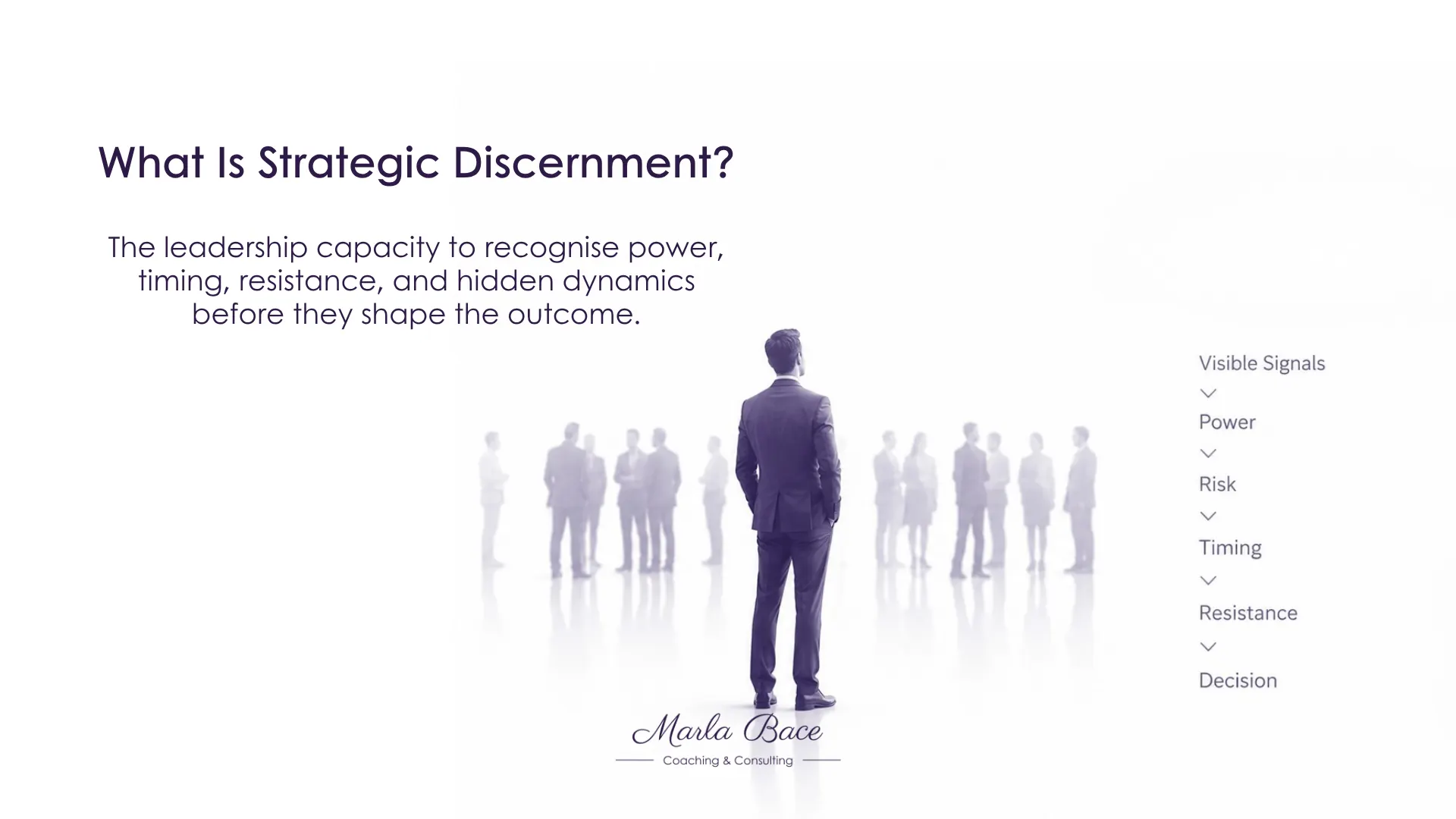
Strategic discernment in leadership is the ability to read what is actually happening in a room, an organization, or a relationship – beneath the stated agenda, beyond the visible data, and before the consequences become obvious.
It is different from emotional intelligence.
Nor is it strategic thinking.
It also differs from gut instinct.
Instead, it is a specific perceptual capacity that allows leaders to operate on reality rather than the version of reality being presented to them.
This matters because senior leadership rarely fails only because someone lacked information. It fails because the leader misread the room.
They took the agenda at face value.
Many assumed agreement meant alignment.
Others mistook politeness for support.
In doing so, they trusted the structure on paper more than the power dynamic underneath it.
That is where discernment becomes decisive. It helps a leader see the room before the room has fully revealed itself. It is the difference between reacting to the meeting you appear to be in and leading inside the meeting you are actually in.
Who Benefits Most From Strategic Discernment in Leadership?
This is not primarily for someone learning basic communication skills or trying to become more polished in meetings.
This is for the senior manager who keeps sensing that the official conversation is not the real conversation.
It is for the director who can feel resistance before anyone names it, but has not always known how to translate that read into a strategic move.
It also serves the executive executive whose role requires them to navigate ambiguity, competing agendas, personality dynamics, board pressure, stakeholder politics, and decisions where the full truth is not stated in one place.
The article is equally relevant for the high-capacity leaderwho has been praised for judgment, trusted with complex work, and pulled into difficult rooms, yet still finds that the organization wants their perception without always granting them the authority to act on it.
It speaks to leaders who have been told they are intuitive, perceptive, intense, sensitive to the room, politically aware, or unusually good at seeing what is coming. Those may sound like personality traits. At senior levels, when developed and disciplined, they become strategic capacity.
The buyer for this work is not looking for another leadership model. They are looking for a more accurate read than they can get from the surface conversation. They want to know why something feels off before it costs them advancement, authority, trust, or a major decision.
If you have ever known something important was happening in the room before anyone named it – and then watched the room move as if that signal did not matter – this is the capacity I am talking about.
What Is Strategic Discernment – And What Is It Not?
Strategic discernment is the capacity to perceive the real operating conditions of a situation and decide from that reality.
It is not emotional intelligence, although emotional intelligence supports it. Emotional intelligence helps you understand emotions, manage reactions, and relate more effectively. Strategic discernment goes further. It asks what those emotions reveal about power, pressure, timing, risk, role clarity, and what the organization is not saying directly.
It is not strategic thinking, although it informs strategic thinking. Strategic thinking helps you analyze options, anticipate outcomes, and connect decisions to broader goals. Strategic discernment in leadershiphelps you know which version of the situation you are actually analyzing.
That distinction is not small. A leader can build a brilliant strategy around the wrong read of the room. The plan may be intelligent, but if it ignores fear, politics, incentives, decision rights, or hidden resistance, it will not move the way the leader expects.
Strategic discernment is also not raw instinct. Instinct may give you a signal. Discernment tests the signal against pattern, context, consequence, and timing. Instinct says, “Something is off.” Discernment asks, “What exactly is off, who is affected by it, what is being protected, and what move fits this reality?”
That is the difference between reacting to a feeling and leading from an accurate read.
Emotional intelligence may help you sense the mood. Strategic thinking may help you build the plan. Discernment helps you decide whether the mood and the plan are even the real issue.
Why Does Strategic Discernment Become the Decisive Variable at the Senior Level?
The Leadership Currency Changes at Senior Levels
At junior and mid levels, technical excellence and hard work are often the primary currency.
You prove you can execute.
Over time, you build trust by delivering.
Eventually, you become known for reliability, skill, responsiveness, and follow-through.
At senior levels, those qualities still matter, but they are no longer enough.
The level shift is that the work becomes less about whether you can complete the assignment and more about whether you can correctly read the environment in which the assignment exists. You are no longer just answering the question. You are determining whether the question itself is the right one.
This is where many capable leaders get trapped. They keep trying to win the next level with the currency that made them successful at the last one.
More effort.
Then comes more preparation.
Followed by greater responsiveness.
Then more polish.
And finally, more proof.
But senior rooms are not moved by effort alone. They are moved by timing, confidence in judgment, stakeholder readiness, risk appetite, informal influence, and the leader’s ability to name what everyone is working around, but no one has yet said clearly.
Reading the Room Becomes the Real Advantage
Strategic discernment in leadership is the hidden variable because it tells you what kind of room you are in. Is this a decision room, a performance room, a protection room, a political room, a grief room, a status-preservation room, or a room pretending to be aligned because no one wants to absorb the consequences of disagreement?
If you cannot read that, you may communicate beautifully and still miss the moment. You may bring the right recommendation to the wrong room. You may mistake silence for agreement, questions for resistance, agreement for commitment, and access for power.
That is how strong leaders lose influence without understanding why. They are not failing because they are unintelligent. They are operating on the stated reality rather than the actual one.
What Does Strategic Discernment Allow You to Do That Other Skills Do Not?
Strategic discernment in leadership allows you to make sound decisions with incomplete information because you are not only relying on what has been documented. You are reading patterns, pressure, incentives, and consequences.
It allows you to navigate without a complete map because you can identify what matters before every detail is visible. You know when the room is ready, when it is performing readiness, and leaders are delaying the decision for reasons no one has put in the deck.
It allows you to understand the role you are actually being asked to grow into, not just the role described in the job description. Sometimes the stated role is about strategy, but the real role is cleanup. In other cases, the title suggests authority, but the structure reserves decision-making authority. Organizations may even say they want change, but rewards the people who maintain the current system.
Discernment helps you see the mismatch before you overcommit to a role that is not designed to let your leadership work.
It also changes how you communicate. Without discernment, you may communicate about the stated issue. With discernment, you communicate to the actual dynamic.
If the stated issue is alignment, but the real issue is fear of accountability, more information will not fix it. When the stated issue becomes resources, but the real issue is decision avoidance, a cleaner plan will not move it. Where performance appears to be the issue, but the real issue is trust, pressure will only create more resistance.
This is why strategic discernment in leadership is not abstract. It changes the sentence you choose, the meeting you ask for, the stakeholder you speak to first, the timing of the recommendation, and whether you push, pause, reframe, or exit.
How Does Strategic Discernment Show Up in a Real Room?
The leadership team says they want faster decisions. The data is available. The recommendation is clear. The timeline matters. On the surface, the room appears aligned.
But a discerning leader notices the hesitation is not about the data. The hesitation is around ownership. No one wants to be the person whose name is attached to a decision that creates internal disruption. The issue is not clarity. It is a consequence.
A less discerning leader keeps adding evidence. They refine the deck, answer more questions, build another scenario, and try to reduce every objection. The work gets heavier, but the decision remains the same.
A discerning leader names the real constraint without making the room defensive: “It sounds like the decision is less about whether this is the right direction and more about what we are willing to own if we move forward.”
That sentence changes the room because it addresses the dynamic rather than the surface topic.
This is the kind of leadership that often looks simple after it happens. It is not simple. It requires the leader to perceive what the room is avoiding and translate it in a way the room can actually use.
What Does Strategic Discernment Look Like Under Pressure?
A senior leader walks into a meeting expecting to secure alignment on a necessary change. The data is strong. The case is clear. No one openly objects. But the room starts asking process questions that do not match the size of the decision.
A less discerning leader keeps clarifying the recommendation. A more discerning leader notices that the questions are not about the quality of the idea. They are about who will absorb the political cost if the change moves forward.
That distinction matters. The issue is no longer the plan. It is ownership, exposure, and consequence.
This is what strategic discernment does in practice. It helps a leader recognize when the room is not debating the idea at all. It is negotiating what the idea will rearrange.
How Does Strategic Discernment Help You Read Power, Timing, and Hidden Resistance?
Power is not always where the org chart says it is. Sometimes, the person with the title has less influence than the person everyone checks with before speaking. In other situations, the formal decision-maker is waiting for informal permission. Often, the meeting is not the decision point; it is the place where a decision already made elsewhere is carried out.
Strategic discernment in leadership helps leaders read those realities without becoming cynical or political for sport. The goal is not to manipulate the room. The goal is to stop being naive about how the room actually works.
It helps you notice who changes the emotional temperature.
Who gets protected?
Which people cannot be challenged directly?
Who is allowed to be strategic?
Whose input is sought only after the direction has already been set? Who absorbs the cleanup when leadership avoids a clear trade-off?
It also helps you read timing.
There are moments when the right move is to speak directly.
At other times, the right move is to seed the idea elsewhere first. There are moments when pushing harder only gives resistance something to organize around. There are moments when silence is not weakness; it is data.
Hidden resistance often shows up as a process.
Another meeting. Then comes another review.
Soon there’s another stakeholder. Another request for data that will not actually change the decision. Strategic discernment helps you ask: Is the organization seeking clarity, or is it buying time because the real issue is too uncomfortable to name?
That reading protects your energy. It also protects your position. Without it, you can spend months trying to solve the wrong problem and then wonder why your influence has not increased.
Why Is the Accurate Read the Core Leadership Advantage?
Precision Creates More Leverage Than Effort
The accurate read is the difference between responding to what people say and leading from what is actually happening.
It is also the difference between effort and leverage. A leader without an accurate read often works harder. A leader with an accurate read works more precisely.
This is where my lens is different from generic coaching or standard leadership development. I am not only listening to the leader’s goals, communication habits, or confidence patterns. I am listening for the room underneath the story: who has power, what is being protected, where the stated feedback does not match the actual pattern, and where the leader is being asked to carry complexity without being given the authority to change it.
That read changes the intervention.
Why Discernment Changes the Intervention
This is where my advisory lens becomes different from generic leadership coaching. I am not only helping a leader communicate better. I am helping them identify the hidden structure of the situation: what is being protected, whose authority is shaping the outcome, where the stated issue is not the real one, and why the room is responding the way it is. That level of discernment changes not just the language, but the entire move.
A generic approach might say, “Be clearer.” Discernment asks, “Clearer to whom, about what, and what happens to the room if the truth is named?”
A generic approach might say, “Build influence.” Discernment asks, “Who already has influence here, why do they have it, and what would make your judgment credible to the people who actually shape the decision?”
A generic approach might say, “Trust your gut.” Discernment asks, “Is this intuition, fear, pattern recognition, old conditioning, or an accurate read of the system?”
That is the edge. Strategic discernment does not make a leader louder. It makes them harder to mislead, misposition, and pull into solving the wrong problem.
How Is Strategic Discernment Developed?
Strategic discernment in leadership is cultivated. Some leaders have a natural sensitivity to pattern, tone, timing, and contradiction. But raw perception is not the same as disciplined discernment.
The capacity develops when a leader learns to slow down the moment and notice what they usually skip past under pressure.
That may include the question no one answers directly. The stakeholder whose silence changes the room. The repeated delay is being called diligence. The vague feedback does not match the results. The role expansion that never comes with authority. The organizational value that sounds good publicly but is not rewarded privately.
Discernment also develops through pattern recognition over time. You begin to see what different kinds of rooms feel like before they announce themselves. You recognize when a conversation is really about power, about fear, about grief, about risk, and about someone protecting an identity they cannot afford to lose.
It develops faster when you work with someone who already operates this way. Not someone who gives advice, but someone who can hear the story and identify its hidden structure.
That is often the missing support for senior leaders. They do not need someone to tell them to be more confident. They need someone who can help them separate their internal reaction from the actual dynamic and then choose a move that fits the real room.
The work is not mystical. It is precise. It is the disciplined practice of noticing what is present, what is absent, what is over-emphasized, what is being avoided, and what the consequences reveal.
The goal is not to become more reactive to every signal. The goal is to become more accurate about which signals matter, what they mean, and which move fits the reality you are in.
What Do Leaders With Strong Strategic Discernment Do Differently?
Leaders with strong strategic discernment do not take every conversation at face value.
In meetings, they listen for the second conversation beneath the first. They notice when a question is really a warning, when agreement lacks commitment, when a delay is really resistance, and when a person is objecting to the consequence rather than the idea.
In decisions, they do not confuse more information with better judgment. They know when the issue is data and when the issue is appetite. They can tell when the team needs clarity, when it needs courage, and when it needs a better container for the truth.
In communication, they do not simply say more. They say what fits the moment. They understand that the same message can land as wisdom, threat, noise, or leadership depending on timing, authority, audience, and room readiness.
In positioning, they stop letting themselves be used only as execution when they are operating with strategic judgment. They can name the level of contribution they are making and align their language, boundaries, and decision rights accordingly.
Over time, these leaders become steadier. Not because they are detached, but because they are less easily confused by surface noise.
They stop personalizing every reaction.
Instead, they stop chasing every moving standard.
Eventually, they stop over-functioning for rooms that are not ready to tell the truth about what they need.
That is what strategic discernment in leadership looks like in practice. It is not being the smartest person in the room. It is one of the few people who can tell what kind of room it is.
What Does Weak Strategic Discernment in Leadership Cost?
Weak strategic discernment is expensive, especially for high-capacity leaders.
It can cost advancement because the leader keeps solving problems at a higher level while still being positioned at a lower one. Their work improves outcomes, but their authority does not rise with it.
It can also trap a leader in a punishing pattern: more effort, more usefulness, more complexity carried – but no meaningful increase in decision weight. That is how high-capacity leaders become central to execution while remaining peripheral to authority.
It can cost credibility because they speak to the surface issue while the real issue remains untouched. They may sound prepared, but not yet powerful. They may be right, but not received.
It can cost an organization its position because they misread where the decision is actually being shaped. They invest in the formal process while the informal conversation determines the outcome.
It can cost self-trust because repeated misreads create confusion. The leader starts asking, “Am I missing something?” when the truth may be that they are sensing the right thing but have not yet learned how to name it, test it, or act from it.
It can also cost energy. Leaders without discernment tend to over-explain, over-prepare, over-adapt, and over-function. They try to make the room safer by carrying more of the work. That may keep things moving, but it does not always build authority.
This is one of the quietest traps in senior leadership: you can become useful to a system you do not yet know how to read. And if you cannot read it, you may keep serving a dynamic that is limiting you.
How Does Marla’s Advisory Lens Support Strategic Discernment?
My work is not built around giving leaders a script for every difficult room. Scripts break when the room changes.
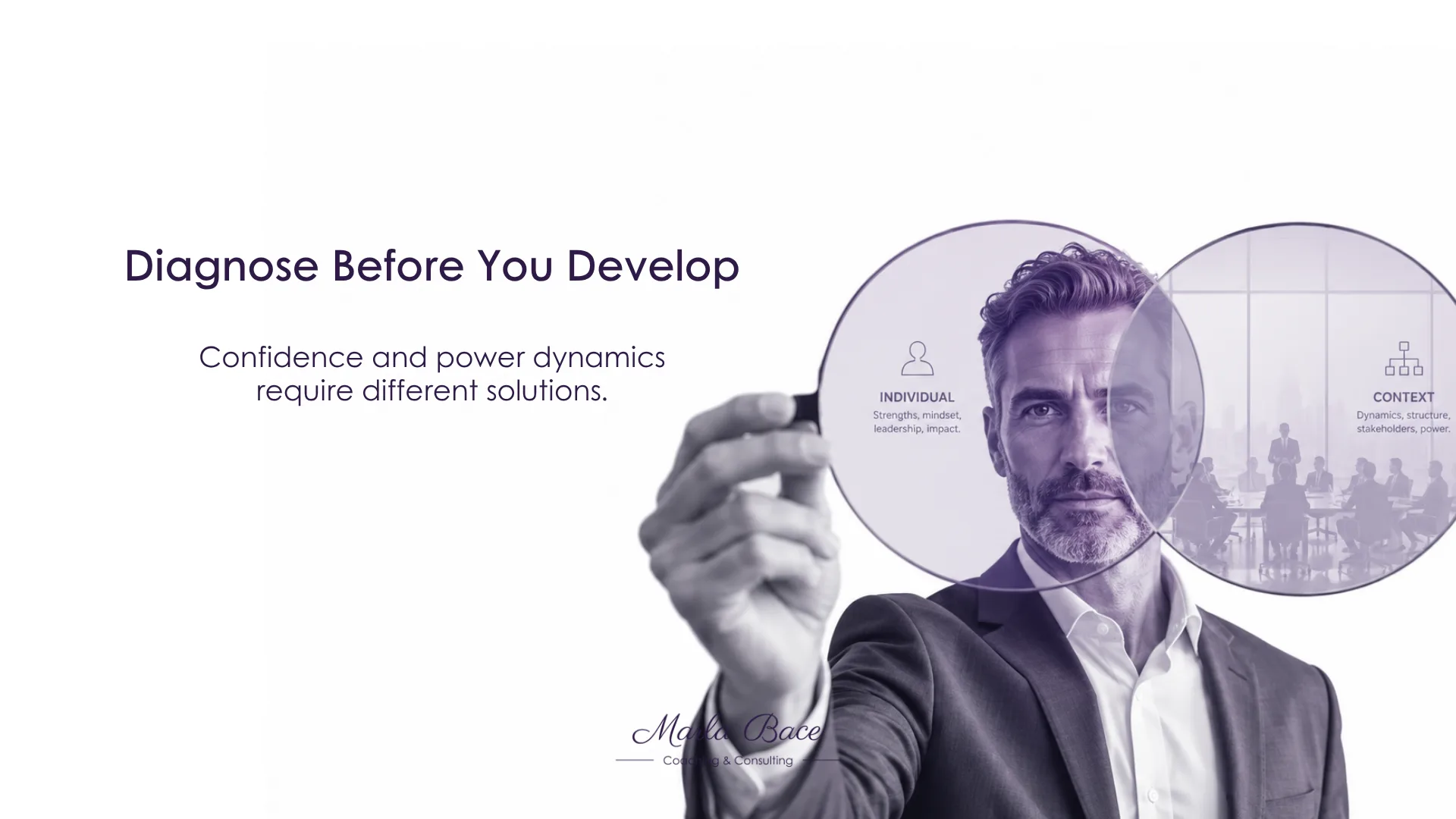
The work is to help leaders develop a more accurate read: what is internal, what is relational, what is structural, what is political, and what is no longer aligned.
I help leaders distinguish the hesitation that belongs to them from the resistance that belongs to the room. I help identify the real players, the hidden constraints, the unspoken power structure, and the places where organizations often underweight, overuse, or miscategorize their contributions.
Then the work becomes practical. We look at language, timing, positioning, boundaries, decision rights, and the next move that fits the actual environment.
The value is not just insight. It is a more accurate read, strong enough to change how the leader moves.
This is why strategic discernment in leadership belongs at the center of the work. Without it, leadership development can become endless self-improvement. With it, the leader can finally see whether the situation calls for a stronger presence, clearer communication, a different stakeholder strategy, a more direct boundary, a renegotiation of authority, or an exit from a structure that will keep consuming their judgment without rewarding it.
Need a More Accurate Read on the Room?
Start with the 15-minute playbook if you need to slow a situation down and tell the difference between surface noise and the real dynamic underneath it.
The playbook helps you read the environment more cleanly: what is being said, what is being avoided, who holds real influence, where the structure dilutes authority.
, and what the room is actually asking of you before you make your next move.
If the pattern runs deeper, the next step is a 30-minute strategy session with me. We look at the actual room, not the abstract leadership issue: who has power, what is being protected, how the situation is being framed, and what move would create a more accurate read and a more effective position.
The goal is not generic encouragement. The goal is discernment strong enough to change what happens next.
Frequently Asked Questions
Strategic discernment is the leadership capacity to read what is actually happening beneath the stated agenda, visible data, or official explanation. It helps leaders understand power, timing, resistance, risk, and relational dynamics before those factors become obvious in outcomes.
No. Emotional intelligence helps leaders understand and manage emotions, relationships, and reactions. Strategic discernment uses emotional intelligence but goes further by reading the signals to understand what they reveal about the system, the room, the decision, and the power dynamics shaping the outcome.
Strategic discernment can be developed. Some leaders may naturally notice patterns, tone, and contradictions. Still, discernment becomes stronger through reflection, pattern recognition, feedback from someone who can read hidden dynamics, and practice in distinguishing internal reactions from external reality.
In practice, strategic discernment looks like knowing when the issue is not the data but the consequence, not the communication but the authority, not the plan but the room’s readiness to own the decision. It changes how a leader speaks, when they move, who they involve, and how they position their judgment.