Leadership decisions require careful thought and experience, especially in challenging situations.
Most leaders don’t make bad calls under pressure.
They make them when everything feels calm.
That’s the moment judgment starts to drift—silently.
When the room agrees.
When no one pushes back.
When the decision feels… reasonable.
Because the signal that something is off isn’t loud.
It’s quiet.
And easy to ignore.
When Leadership Decisions Feel Too Easy
You walk through the issue.
People share perspectives.
Questions get answered.
Then it lands.
Everyone agrees.
The room agrees.
No one pushes back.
And suddenly the decision feels… reasonable.
Research on group decision-making, including work highlighted by Harvard Business School, shows that when consensus forms too quickly, critical thinking often drops—what feels like alignment can actually suppress dissent. See link:
That’s the point when most leaders exhale—and stop listening.
It feels clean — like alignment.
But those aren’t the same thing.
**Agreement closes the conversation. Alignment tests it.**
And when the room gets comfortable too quickly, leaders stop asking:
What are we not challenging here?
If this is already familiar, you don’t need more content—you need to stay in this level of thinking.
→ Join Presence is Power
Why Leaders Delay Difficult Decisions
Nothing gets decided.
But it doesn’t feel like avoidance.
It feels thoughtful.
“We need more time.”
“Let’s let this play out.”
“Not the right moment yet.”
Not because you don’t know what to do — because you know what it will cost.
This is where emotional intelligence works against you.
You can see the impact.
At the same time, you understand the people involved.
More importantly, you know what the change will require.
So you wait.
What Comfortable Decisions Protect
Comfortable decisions protect something.
It rarely protects the business.
And it’s usually not protecting the outcome either.
Something closer.
- identity (“this isn’t how I lead”)
- relationships (they’ve been here a long time”)
- perception (“this will change how I’m seen”)
That’s the quiet line where logic turns personal.
The decision shifts.
Not outwardly.
Internally.
From:
What actually needs to happen?
To:
What can I live with?
A Real Example of Where This Breaks
A client of mine had already done the work before we met.
He brought in multiple consultants.
They all said the same thing: remove the part of the business that was damaging performance.
He didn’t.
Not because he disagreed — because acting on it conflicted with who he believed he was as a leader.
So instead, he made the comfortable decision.
He waited.
Where the Shift Actually Happened
It didn’t happen when someone told him what to do.
He’d already heard that.
It happened when the question changed.
What am I protecting by not making this decision?
What is this costing me every month I wait?
Not easier. Clearer. And that’s when momentum returned.
The Decision That Doesn’t Feel Good—But Lands Clean
When he finally made the decision, it wasn’t comfortable.
There was no immediate relief.
It was disruptive.
Unsettling.
Exactly what he had been avoiding.
But something shifted.
Progress turned quiet again — but this time, it was movement, not stagnation.
“The business started moving.
The team stabilized. The energy shifted.”
And he said:
“I didn’t realize how much I was carrying until I stopped trying to make that work.”
Why the Right Decision Often Feels Wrong
The right decision often feels:
- disruptive
- uncomfortable
- misaligned with how you see yourself
The wrong one feels:
- calm
- supported
- easy
**That’s the trap.**
You’re not choosing between right and wrong.
You’re choosing between:
→ short-term comfort
→ long-term clarity
What to Pay Attention to Instead
Not consensus.
Not convenience.
Pay attention to:
– what keeps resurfacing
– what hasn’t actually resolved
– what you keep thinking about after the meeting ends
Those are the decisions that require more attention.
The Question That Cuts Through It
Most leaders ask:
Is this the right decision?
A better question:
Why does this decision feel so comfortable?
**Because comfort is data.**
It tells you something.
The question is whether you’re willing to look at it.
Where This Leaves You
If there’s a decision in your world right now that:
- keeps getting revisited
- feels settled but not resolved
- is easier to explain than it is to stand behind
That’s the one to look at.
Not because it’s urgent.
Because it’s already costing you.
A Final Reflection
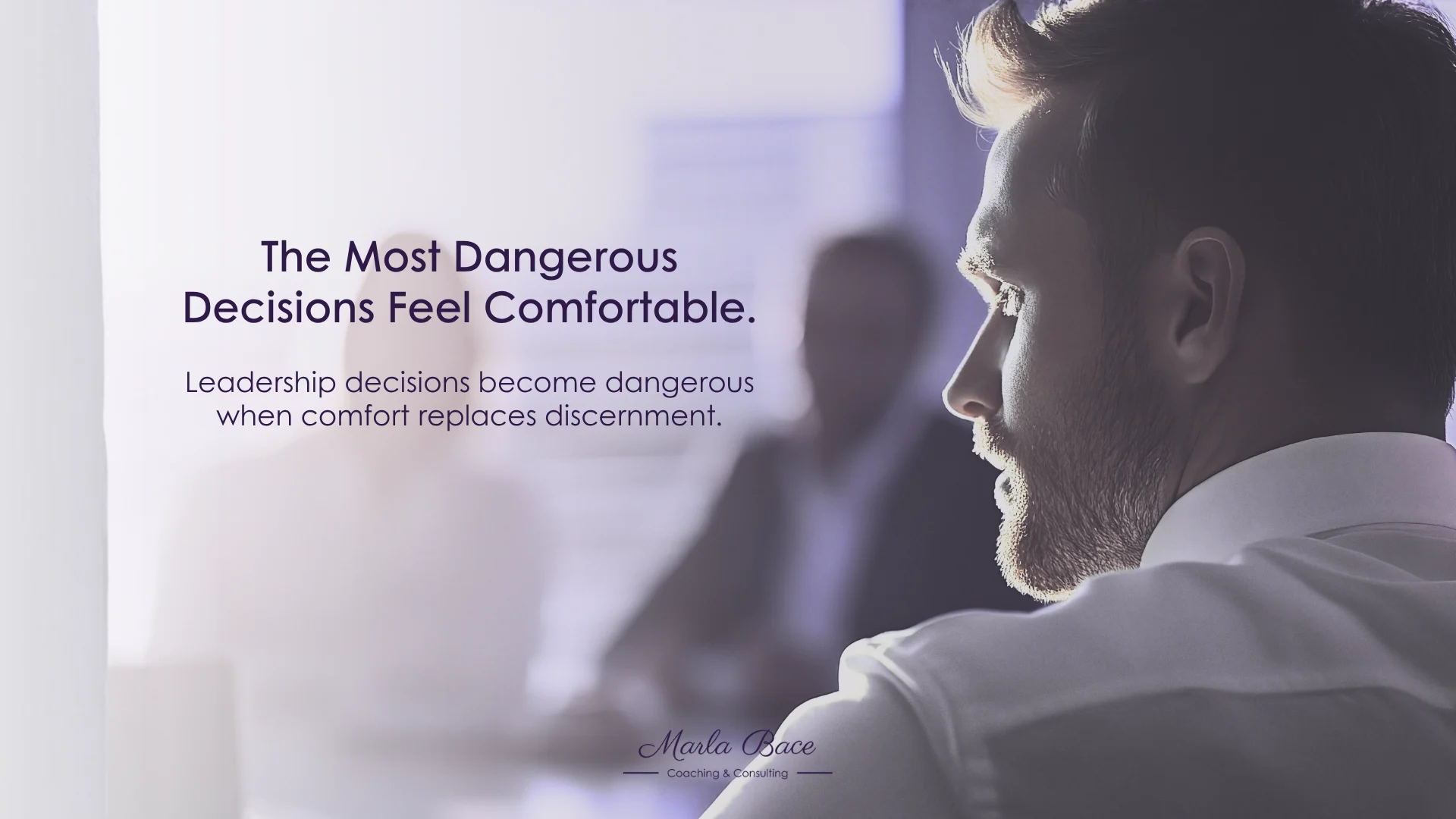
The most dangerous leadership decisions are rarely the ones made under pressure.
They’re the ones made in comfort.
Because comfort can hide:
what’s unresolved
what’s avoided
what you already know but haven’t acted on
Clarity often starts where comfort ends.
If A Decision Keeps Returning, There’s Usually A Reason.
The decisions that create the most long-term damage are rarely the loudest.
They’re the ones that: feel reasonable, stay unresolved, keep resurfacing after the conversation ends
A Clarity Review helps identify where comfort, consensus, or emotional protection may be interfering with clear leadership judgment and strategic direction.
A short, focused session to help you see what’s yours to carry—and what isn’t.
Common Questions Leaders Ask at This Stage
Leadership decisions often feel easier when they protect comfort, identity, relationships, or perception. The absence of tension can create a false sense of clarity, even when important issues remain unresolved.
Leaders often delay difficult decisions because they understand the emotional, relational, or organizational consequences involved. The delay usually comes from what the decision threatens—not from lack of awareness.
Comfort can weaken leadership judgment by reducing critical evaluation and suppressing internal resistance. Decisions that feel calm or universally supported are not always strategically aligned.
Decision avoidance happens when leaders postpone action while framing the delay as strategic thinking, timing, or caution. Often, the real issue is the emotional cost attached to the decision.
Consensus becomes dangerous when agreement forms too quickly and reduces critical thinking. Strong leadership decisions require testing assumptions, challenging alignment, and examining unresolved tension.