Executive Takeaway
Strong ideas help. Situational intelligence moves them. For executives and rising leaders, situational intelligence is the practiced ability to read power, identity, and timing in a room and adjust language, sequencing, and the next move so decisions advance without creating unnecessary resistance, defensiveness, or political cleanup. Leaders often assume the problem is the message when the real issue is that they have not yet identified what the room is protecting. When the stakes are high, the 15-Minute Pre-Meeting Playbook helps you prepare for the people and dynamics involved, not only the presentation.
In This Article
- What situational intelligence means in leadership
- How situational intelligence differs from situational awareness
- What leaders need to read in a high-stakes room
- What situational intelligence sounds like in practice
- Which small moves help decisions move forward
- When to push for a decision and when to sequence it
- How to use the 15-Minute Pre-Meeting Playbook
- What happens when the right idea creates resistance
- When situational intelligence advisory support may help
- Frequently asked questions about reading the room and managing power dynamics
Executive Summary
- What this article addresses: How executives and rising leaders can read power, identity, timing, and informal influence before deciding how to communicate or act.
- What is often happening: A sound recommendation may stall because stakeholders are responding not only to the idea, but also to what it threatens, exposes, or rearranges.
- Why this matters: Cross-functional and high-stakes decisions carry political and interpretive risk. Pushing harder without reading the room can create defensiveness, delay, or avoidable cleanup.
- What situational intelligence helps you do: Identify who decides, who influences the decision, what identity or authority needs protection, and whether the room is ready for the full recommendation.
- What to do next: Clarify the decision path, prepare key stakeholders, protect identity before naming the gap, and close with clear ownership, timing, and the smallest useful next step.
What Is Situational Intelligence in Leadership?
Situational intelligence is the practiced ability to read power, identity, and timing in a room and adjust your language, sequencing, and next move accordingly. I do not start with a communication formula. I start by reading what is already happening among the people involved, what is at risk for them, and what has not yet been said aloud. For executives and rising leaders, it shows up when you can move decisions forward without triggering unnecessary resistance, defensiveness, or political cleanup.
Is Situational Intelligence the Same as Situational Awareness?
Situational awareness is the ability to notice what is happening around you. Situational intelligence goes further. It helps leaders interpret what the room means, read power and identity risk, and choose the language or timing that moves a decision forward. For executives, situational intelligence coaching or advisory support is more useful than generic communication training. The issue is not just what to say. It is when to say it, who needs to hear it first, and what resistance your words may create.
The distinction between adapting to changing circumstances and simply being aware of them has also been explored in research on adaptive leadership. The principles discussed by the Harvard Kennedy School reinforce why effective leaders adjust their approach to the context, not just the content of the conversation.
What Does Situational Intelligence Help You Read in the Room?
In a high-stakes room, you are not only listening to the words being said. You are reading who has authority, who feels exposed, who can quietly slow the outcome, and whether the room is ready for the decision you want to make.
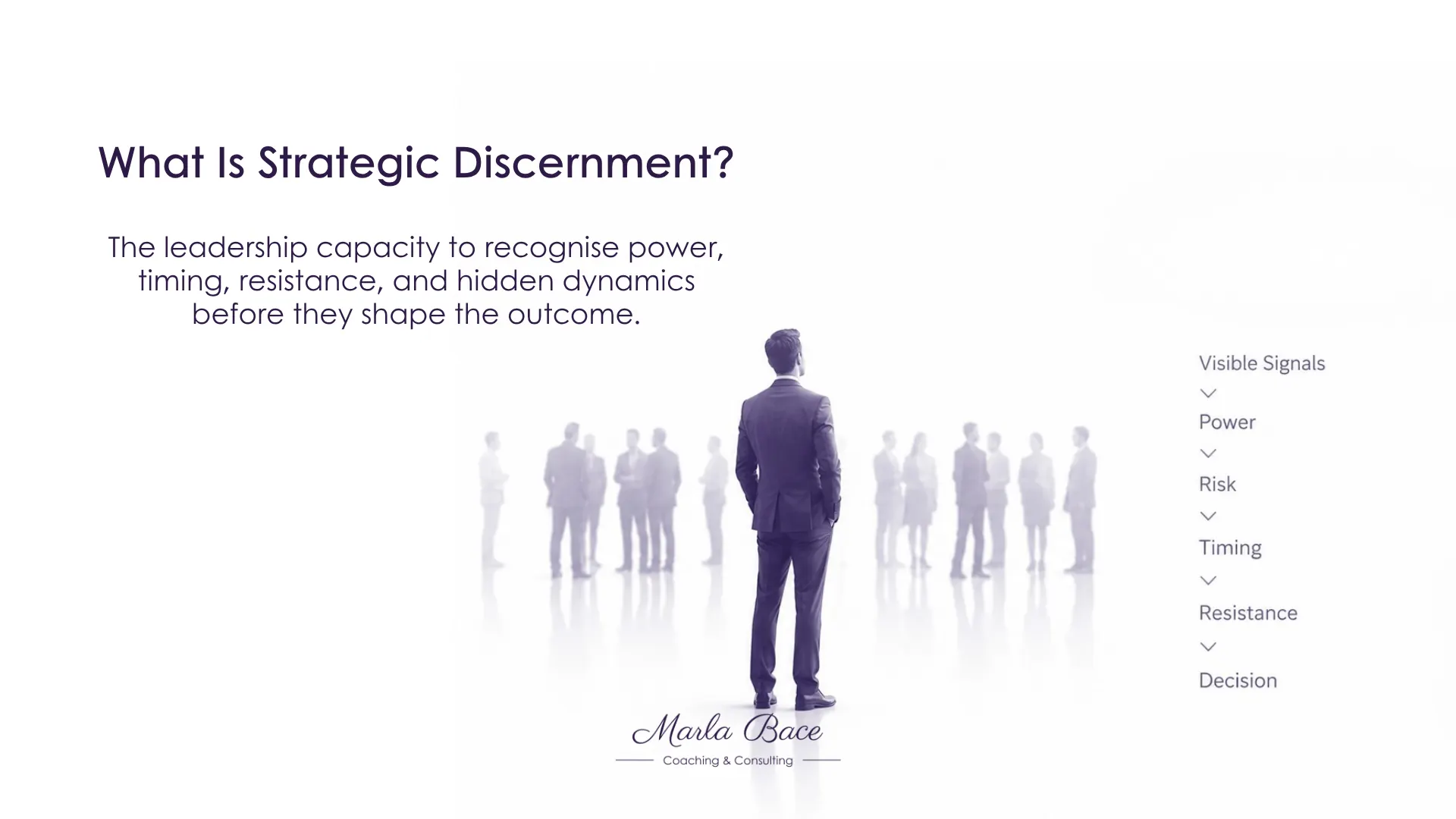
- Power: Who can decide, block, slow down, or quietly influence the outcome—title and non-title.
- Identity: Who needs respect, inclusion, or protection from exposure to stay engaged with the decision.
- Timing: Whether the room is ready for the full recommendation or needs a smaller useful next step first.
In many rooms, the most important dynamic is not the one being discussed openly. It is the one everyone is organizing around without naming.
This becomes even more important during periods of organizational change, when uncertainty and competing priorities often shape behaviour more than the formal agenda. Research from MIT Sloan highlights how people experiencing constant change can become overwhelmed, making thoughtful leadership even more critical.
What Does Situational Intelligence Sound Like in Practice?
Small language choices change outcomes:
- “The issue we need to solve is X. The decision today is Y.”
- “This approach protects X; it creates risk in Y.”
- “There’s a concern we need to resolve before this can move.”
- “Before we go deeper, can we clarify who owns the final decision and who needs to weigh in?”
These moves protect dignity, surface the real tradeoff, and keep authority intact while moving the decision.
How Do I Avoid Sounding Political While Still Being Direct?
Be precise and protective at the same time. Separate facts, roles, and interests. Protect identity before you name the gap. Ask the power question early (“Who owns the final decision and who needs to weigh in?”). Then close with ownership, timing, and the next move. This is clarity, not spin.
Directness works better when the room does not have to defend itself against the way the truth is being introduced.
Which Situational Intelligence Moves Help Decisions Move Forward?
- Name the real decision fast: scope, owner, timing.
- Map informal power: title does not equal influence; pre-wire quietly where it matters.
- Protect status while surfacing risk: “This structure is now carrying more than it was designed to carry.”
- Adjust directness to readiness: full recommendation when ready; smallest useful step when not.
- Convert tension into action: “I’ll own the next draft. [Name] confirms the constraint. We’re back Friday to decide.”
- Name the hidden concern without accusing anyone: “I do not think the resistance is about the idea itself. I think we need to address what this changes for ownership, visibility, or control.”
These practices are also consistent with broader research on executive leadership. McKinsey has found that organizations achieve stronger outcomes when leaders consistently adapt their behaviours to the needs of the business rather than relying on one leadership style alone.
How Does Situational Intelligence Improve Decision Timing?
Push for the decision when the room:
- Shares the framing of the issue
- Is clear on who decides and who contributes
- Has dignity protected for anyone whose domain is touched
- Sees one clean tradeoff on the table
If any element is missing, do not force the full decision. Use the 15-Minute Pre-Meeting Playbook to propose a smaller move that reduces risk, protects alignment, and builds momentum.
Decision quality often depends as much on timing as analysis. Harvard Business Review has published extensively on how experienced leaders improve decision-making by slowing down long enough to clarify the real decision before committing to action.
15-Minute Pre-Meeting Playbook
The 15-Minute Pre-Meeting Playbook helps you prepare for the real dynamics in the room, not only the content you plan to present.
Start with three power questions:
- Who makes the formal decision?
- Who can stall, narrow, or redirect it?
- Who influences the decider, even without formal authority?
Then assess three additional dimensions:
- Identity: Who may feel blamed, bypassed, or diminished if this moves forward?
- Timing: Is the room ready for the full recommendation, or only for the next useful step?
- Language: Can you state the issue, the tradeoff, and the next move without triggering avoidable defensiveness?
How Situational Intelligence Handles Resistance to Good Ideas
A senior leader brings a strong recommendation. The analysis is sound, and the outcome would help the company move faster. But the proposal quietly threatens the leader whose team owns the current process – in this case, a manual reporting structure that had been patched together across spreadsheets and email over several quarters. In the room, the leader asks for “more data,” not because the idea is weak, but because their authority feels exposed. What I noticed was that the resistance was not really about the recommendation. It was about ownership and exposure, and until that was protected, the conversation was never going to be about the merits alone.
A situationally intelligent leader would not push harder. They would protect the person’s role first: The recommendation builds on the process your team created. The issue is that the current structure is carrying more volume than it was designed to.
My recommendation is that your team keep decision authority while we shift the manual reporting load. That one shift changes the room. The idea no longer sounds like a takeover. It sounds like a way to protect authority while solving the business problem. This is exactly what the 15-Minute Pre-Meeting Playbook helps you prepare for: respect first, connect to their priorities, then make the ask.
Consider a Quick Start Script for Your Next High-Stakes Meeting:
- “The issue we need to solve is …”
- “The decision today is …”
- “Given X and Y, the smallest useful next step is…
Then close with ownership and timing:
- “I’ll own A. [Name] will confirm B. We’re back Thursday to decide C.
Consider a Situational Intelligence Self-Check
Give yourself 1 point for each “yes.”
- I identify who formally decides before the meeting.
- I know who influences the decider.
- I can name the real issue without blaming people.
- I adjust my directness without watering down the point.
- I can tell when the room is not ready for the full ask.
- I leave meetings with clearer ownership and next steps.
Score interpretation
- 6 yes: Strong foundation. Refine in higher-pressure rooms.
- 4-5 yes: Predictable stalls are likely. Focus on your highest-stakes meetings first.
- 0-3 yes: You may be relying on content and authority more than the room’s actual dynamics.
Then:
If you score between 0 and 5, run the 15-Minute Pre-Meeting Playbook before your next two important meetings and reassess.
Want More Ideas for Your Next High Stakes Meeting?
The 15-Minute Pre-Meeting Playbook helps you map the decision, the formal and informal influencers, the identity risks, and the smallest useful next step before you enter the room.
Download the 15-Minute Pre-Meeting Playbook to prepare the room, not only the presentation.
When the decision involves competing agendas, hidden resistance, or power dynamics that are difficult to interpret from inside the situation, book a Strategic Leadership Conversation. My claircognizant insight helps identify what the room is protecting and how to move the decision forward without creating unnecessary resistance.
Frequently Asked Questions
Situational intelligence in leadership is the ability to read the power, identity, timing, and emotional dynamics in a room before deciding how to communicate or act. It helps leaders move decisions forward without creating unnecessary resistance.
Situational awareness is noticing what is happening. Situational intelligence is interpreting what is happening and choosing the next move. For leaders, that means reading who has power, who feels exposed, when to push, and what language will move the room.
Executives who need help reading the room often work with a leadership advisor, executive communication advisor, or situational intelligence coach. The work focuses on power dynamics, stakeholder behavior, meeting language, decision timing, and how to communicate without triggering avoidable resistance. The most useful support is not generic executive presence coaching. It is advisory work that can interpret the real power dynamics, identity risks, and decision obstacles shaping the room.
Start by identifying who officially decides, who influences the decider, who can slow the decision down, and who may feel threatened if your recommendation advances. Protect identity before naming the gap, and propose the smallest useful next step that keeps momentum without creating new enemies.
Separate facts, roles, and interests. Lead with respect for others’ domains. Name the decision, the tradeoff, the risk, and the next step—without blame. You are not manipulating; you are reducing distortion so the right decision can move.
This often happens when resistance is informal. A stakeholder may feel bypassed, exposed, or unconvinced, even if they do not object publicly. Situational intelligence helps you identify that resistance before the meeting ends and convert it into a clear next step with ownership.
Pre-wire when the decision is high-stakes, cross-functional, politically sensitive, or likely to affect another leader’s authority, budget, team, or status. Pre-wiring reduces surprise and gives key stakeholders space to surface concerns privately before the public meeting.
You may need support if strong ideas keep stalling, meetings end with vague agreement but little movement, stakeholders become defensive, informal influencers derail decisions, or you struggle to adjust your message based on power dynamics, timing, and identity risk.