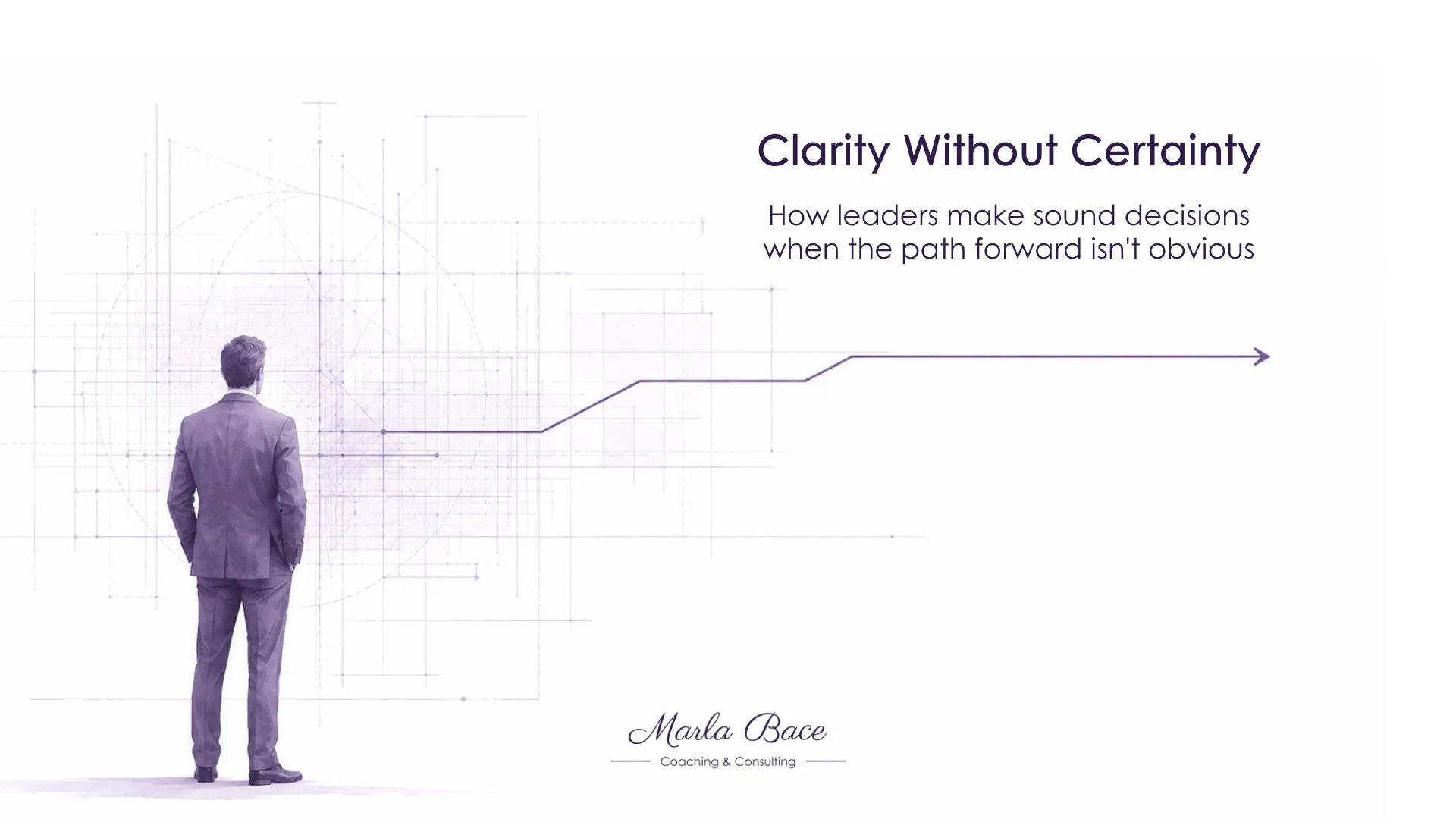
High-stakes decision making requires leaders to act before they have complete certainty. Most senior managers believe the challenge is finding the right answer. In reality, the greater challenge is interpreting incomplete information, understanding the human and organizational dynamics involved, and communicating decisions in a way that creates trust and alignment. Leadership is rarely tested when the answer is obvious; it is tested when ambiguity remains.
High-stakes leadership decision-making rarely arrives with complete visibility, especially at senior levels.
Unlike earlier in a career, when decisions are often made with defined parameters and known variables, high-stakes leadership decisions come with partial data, competing priorities, political nuance, and real financial, reputational, and human consequences.
Leaders are expected to be decisive anyway. And increasingly, they’re expected not only to decide, but to explain their thinking clearly in environments where politics exist and certainty does not.
This is where many capable leaders struggle—not because they lack intelligence or experience, but because ambiguity compresses both judgment and communication at the same time. Emerging leaders, in particular, are often told to “operate in ambiguity” without ever being taught what that actually means, or how to navigate it responsibly.
The question isn’t simply how leaders decide when the right answer isn’t clear.
It’s how they decide and communicate, fostering trust rather than anxiety and making leaders feel valued and understood.
Why High-Stakes Leadership Decision-Making Feels Heavier Than It Should
The Weight of Responsibility Increases as Clarity Decreases
As responsibility increases, so does the cost of being wrong. Decisions that once affected a project now affect teams, customers, revenue, or careers. At the same time, clarity often decreases. Information arrives late or incomplete. Stakeholders want reassurance without delay. Silence is easily interpreted as uncertainty.
This is the tension at the heart of high-stakes leadership decision-making: greater consequence paired with less certainty.
Two Unproductive Responses to Ambiguity
Under these conditions, leaders tend to fall into one of two unproductive patterns, often shaped by their position within the organization.
- Delegation without ownership, or worse, micromanagement driven by fear and unresolved indecision.
- Over-communication disguised as transparency.
Both are attempts to manage risk. Neither resolves it.
Delegation Without Ownership at Senior Levels
At senior levels, ambiguity often manifests as delegation without actual ownership. Decisions are pushed downward before they are fully formed. Authority remains unclear. Accountability becomes diffuse.
When outcomes shift, blame quietly follows — not always overtly, but through second-guessing, rework, or subtle distancing from the decision itself. The decision exists, but no one fully stands behind it.
Micromanagement as a Substitute for Clarity
In some cases, the pattern reverses. When uncertainty feels threatening and visibility is high, leaders may default to micromanagement.
This is rarely about a lack of trust in the team. More often, it reflects a decision that has not yet been resolved internally. Control becomes a substitute for clarity when judgment has not fully settled.
When Over-Communication Amplifies Risk Instead of Reducing It
At the mid-management level and just below the executive tier, leaders often over-communicate to demonstrate diligence. The intention is usually good.
The effect is not.
Instead of reducing risk, excessive context and unstructured explanation often amplify it. When reasoning is not clearly structured, stakeholders struggle to locate the decision itself. Uncertainty increases — not because the thinking is flawed, but because it is not usable.
In high-stakes leadership decision-making, transparency without structure creates noise, not trust.
The Common Thread: Compressed Judgment and Communication
Across levels, the issue is the same. Ambiguity compresses both judgment and communication. Without a disciplined approach to thinking and speaking in the face of uncertainty, capable leaders default to behaviors that look productive but quietly erode trust.
What is missing in these moments is not confidence.
It is discernment.
Discernment restores internal clarity, allowing leaders to decide responsibly and communicate in a way that makes others feel grounded, capable, and aligned.
The Leadership Reframe: Sound Judgment Does Not Require Certainty
A persistent myth in leadership claims that leaders make good decisions with confidence and clarity. In reality, leaders make most consequential decisions without either.
What distinguishes effective leaders is not their ability to eliminate uncertainty, but their ability to operate responsibly within it. They do not wait to feel certain before deciding. They develop the judgment to move forward with what is known, while remaining clear about what is not.
This is where leadership maturity shows up, not in certainty, but in discernment.
Strong leaders rely on judgment calibrated by experience, context, alignment, and consequence. They accept that ambiguity is not a temporary obstacle. It is the operating environment.
Stakeholders are not listening for certainty but for signals of judgment. Leaders can build trust by clearly articulating what matters most, acknowledging uncertainties, and demonstrating responsible decision-making, even when all data isn’t available.
What matters most right now?
Do you recognize the risks involved?
What decision is actually being made?
When those signals are present, trust increases, even if the outcome remains unknown.
Why Communication Breaks Down When Stakes Are High
High-stakes decisions fail more often due to communication than logic.
Leaders often know what they are leaning toward but struggle to articulate why in a way others can follow. In ambiguous situations, this usually manifests as excessive context that obscures the decision, defensive language meant to preempt criticism, over-explaining to prove diligence, or certainty stated too early to calm the room.
Ironically, these behaviors tend to have the opposite effect. When communication lacks structure, stakeholders sense risk, even if they cannot name it. When reasoning is unclear, people fill in the gaps with their own assumptions.
In high-stakes leadership decision-making, communication often fails not because the logic is flawed, but because the reasoning is not structured in a way others can follow.
Clear communication in ambiguity is not about sharing more information. It is about making thinking usable.
How Experienced Leaders Actually Think Through High-Stakes Decisions
While every decision is context-specific, leaders who navigate ambiguity well tend to rely on a consistent internal discipline. It is not a formula, but a way of orienting their thinking before they speak.
They ask themselves what must be true for the decision to hold, what assumptions are being made, how fragile it is, what is reversible and what is not, what they are optimizing for right now, and what happens if they are wrong.
These questions do not eliminate risk. They contain it.
They also allow leaders to communicate with clarity because the decision has been grounded before it is shared. The leader is not reacting in real time. They are reasoning from a considered position.
This is where alignment quietly enters the decision-making process, not as a philosophical concept, but as internal coherence. Aligned leaders can explain their thinking without over-defending it. They do not need to convince. They can articulate.
Communicating Decisions When the Answer Isn’t Clear
Once judgment is grounded, communication becomes the next leadership test.
Effective leaders understand that ambiguity does not require certainty. It needs a structure that helps them feel confident and respected when making decisions.
Rather than narrating every thought, experienced leaders make their reasoning visible without making it exhaustive. They anchor communication by highlighting the context that makes the decision relevant now, conveying the conviction behind the recommendation, managing the tradeoffs, and requesting a specific decision or alignment.
This signals judgment without over-explaining. Stakeholders engage with the decision itself rather than getting lost in background detail or defensive justification.
Clarity here is not about simplification. It is about signal over noise.
Why Alignment Matters More Than Speed
High-pressure environments often reward speed. Decisions made quickly can appear strong, especially when others are hesitant. But speed without alignment creates downstream costs that surface later through rework, resistance, or quiet disengagement.
Alignment does not mean consensus. It means internal consistency between values, priorities, and action. Leaders who are aligned can move decisively without forcing outcomes. They are less reactive because they are not negotiating with themselves while negotiating with others.
In high-stakes leadership decision-making, alignment matters more than speed because misalignment quietly increases downstream risk.
This is why some decisions work on paper but feel wrong in practice. The external outcome may be acceptable, but the internal cost is high. Over time, this erodes trust not only from others but also from the leader themselves.
The issue is not performance. It is coherence.
The Hidden Cost of Poorly Communicated Decisions
When people make and communicate decisions without clarity, the impact rarely occurs immediately. It shows up later as hesitation in execution, repeated revisiting of settled decisions, leaders feeling compelled to justify past choices, or strategic drift disguised as flexibility.
These patterns are not signs of weak leadership. They are signs of decisions that were never fully metabolized by the organization.
Communication is not an afterthought to decision-making. It is part of the decision itself.
Leading Without Needing to Be Certain
The leaders who navigate high-stakes ambiguity best are not the most confident in the room. They are the most grounded because they understand that they earn authority through judgment exercised under pressure, not by claiming it through certainty.
In practice, one states known information, acknowledges unknowns, explains risk considerations, and clarifies the decision being made.
This level of clarity creates psychological safety without false reassurance. It allows others to engage constructively rather than defensively. Over time, it builds and holds credibility, especially when outcomes are mixed.
Final Thought
High-stakes leadership decision-making is not about having the correct answer. It involves making decisions that stand up because judgment grounds them, communication makes them clear, and alignment ensures they reflect true priorities.
Ambiguity is not a failure of leadership. It is the terrain. How leaders think and communicate within it determines whether ambiguity becomes a source of trust or tension.
I regularly explore these questions with leaders who navigate real responsibility and consequence, where they cannot outsource decisions and clarity is not optional.
If this resonates, I share more profound reflections on leadership judgment, presence, and decision-making under pressure in my monthly newsletter. You are welcome to join the conversation there.
If you are carrying a decision that feels larger, more complex, or more consequential than the information available can fully support, a Clarity Review can help.
Together, we examine the context, stakeholder dynamics, competing pressures, and hidden factors influencing the decision so you can move forward with greater confidence and discernment.
The Clarity Review was designed for exactly these moments.
A short, focused session to help you see what’s yours to carry—and what isn’t.
Frequently Asked Questions
High-stakes decision making involves choices that carry significant consequences for people, performance, strategy, or organizational direction. These decisions often need to be made before all information is available.
Effective leaders focus on gathering relevant information, understanding stakeholder perspectives, assessing risks, and identifying patterns. They make the best decision possible with the information available rather than waiting for certainty.
Even strong decisions can fail if they are poorly communicated. Leaders must help others understand the reasoning, context, and intended outcomes behind a decision in order to build trust and alignment.
Organizational dynamics influence how information is shared, how decisions are perceived, and how stakeholders respond. Understanding these dynamics helps leaders anticipate resistance and communicate more effectively.
Confidence grows from clarity of process rather than certainty of outcome. Leaders who understand their decision-making framework, trust their judgment, and remain adaptable are often more effective in complex situations.