Executive Takeaway
A difficult work situation does not automatically mean you should leave. Some problems improve when expectations are clarified, communication changes, or the role is redefined. Others persist because the organization’s operating structure leaves no real space for reflection, repositioning, or recovery. Situational intelligence helps you distinguish a difficult season that can respond to intervention from a system that continues asking you to absorb the cost of its dysfunction.
In This Article
- Why capable professionals stay too long or leave too quickly
- How to distinguish a difficult season from a structural pattern
- What evidence shows that a situation can still improve
- Which signs suggest the organization is unlikely to change
- How communication systems, pace, and cognitive load shape the answer
- What to test before deciding whether to stay
- What happens when the person keeps seeking solutions inside a system with no room to use them
- How an outside perspective helps separate possibility from exhaustion
- What to do before making a final decision
- Frequently asked questions about adapting, staying, and leaving
Executive Summary
- What this article addresses: The decision to remain in, adapt to, or leave a work situation that has become increasingly heavy, reactive, or misaligned.
- What is often happening: The professional keeps searching for a better communication strategy or stronger performance approach while the organization’s pace and operating structure leave little room for either to take hold.
- Why this matters: Leaving too quickly can abandon a repairable situation. Staying too long can drain judgment, confidence, health, and career momentum.
- What situational intelligence helps you do: Read how the system actually responds to reflection, boundaries, clarity, and reasonable attempts to change the way the work is carried.
- What to do next: Test whether the environment can create space for a different operating pattern, then decide from evidence rather than hope, fear, or exhaustion.
Why Is It So Hard to Know Whether to Stay in a Difficult Work Situation?
The decision is difficult because most work situations are neither entirely healthy nor entirely dysfunctional. A role can still offer income, access, meaningful work, status, or future opportunity while also becoming increasingly difficult to sustain. A manager may be supportive in one conversation and unavailable in the next. The organization may acknowledge the problem without changing the conditions that create it.
Capable professionals often assume that if they can communicate more clearly, work more strategically, or reposition themselves more effectively, the situation will improve. Sometimes it does. But I have also seen people keep refining themselves inside a system that has no practical capacity to receive the change. At that point, the issue is no longer whether the person has found the right tactic. It is whether the environment can make use of one.
The central question is not simply, “Can I tolerate this?” It is: “Can this environment respond meaningfully when the problem is named?”
Why Do Strong Performers Stay Too Long?
Strong performers build careers by adapting. When the environment becomes difficult, they increase effort, become more responsive, and search for a better way to influence the situation. Their competence tells them the problem should be solvable.
- They try another communication approach.
- They become more available so no one can question commitment.
- They work around missing processes rather than stopping to challenge them.
- They wait for the next reorganization, leader, or planning cycle.
- They interpret exhaustion as evidence that they need to become more efficient.
- They believe stronger performance will eventually change how they are perceived.
Those responses can be useful in a difficult but workable environment. My concern begins when adaptability becomes the mechanism that allows the organization to avoid changing. The person keeps solving around the structure, and their competence becomes evidence that the structure is sustainable when it is not.
Why Do Other Professionals Leave Too Quickly?
The opposite mistake also occurs. A person may experience a demanding season, a difficult manager, or a transition in role expectations and conclude that the situation is irreparable before testing whether it can respond.
A workable situation may feel intolerable because expectations have not been clarified, authority needs to be renegotiated, communication patterns have deteriorated, or the person is still using an operating approach that belonged to an earlier version of the role.
Discomfort is not, by itself, proof that the system cannot change. I look for response, not reassurance: what happens after the problem is accurately named and a reasonable alternative is introduced? A workable environment may resist at first, but it can still metabolize new information. A fixed system repeatedly absorbs the conversation and returns everyone to the same operating pattern. Is your operating system fixed or flexible?
What Does a Workable Difficult Work Situation Look Like?
A difficult situation may still be workable when:
- The problem can be named specifically rather than only felt.
- The relevant leader is willing to engage with evidence.
- Expectations become clearer after discussion.
- Communication or decision rights can be adjusted.
- Agreements lead to observable changes in behavior.
- The organization can create time to review what is and is not working.
- There is a credible decision-maker with the authority to act.
- The person can recover enough cognitive space to think, not only react.
My view is simple: promises are not evidence. Agreement is not evidence. A change in the operating pattern is evidence. Are you able to impact the operating pattern?
When Does a Difficult Work Situation Become a Structural Problem?
A structural problem is a repeated pattern in which the organization’s way of working prevents meaningful change, even when the people involved understand that something is wrong.
- Everything is treated as urgent, so reflection is continually postponed.
- Communication happens through fragments rather than coherent conversations.
- Work moves from sprint to sprint without a real opportunity to review the larger direction.
- The person is expected to solve the problem while remaining fully submerged in it.
- Attempts to create boundaries are interpreted as reduced commitment.
- The organization values responsiveness more than judgment.
- There is no stable forum in which perceptions, priorities, or roles can be reconsidered.
- The person’s identity inside the organization has become fixed, and new behavior is interpreted through the old story.
In that kind of system, better communication can improve an individual exchange without changing the larger pattern. I do not believe every communication problem is solvable through better language. Sometimes the language is sound and the system has nowhere to put the truth once it has been spoken.
How Communication Shapes a Difficult Work Situation?
Organizations do not only communicate through what people say. They communicate through pace, meeting structure, decision cycles, and the amount of space available for reflection.
A technology-driven organization may rely heavily on messaging channels, rapid updates, and sprint-based work. That structure can be highly effective for execution. It becomes limiting when nearly every issue is compressed into short exchanges and immediate deliverables.
Without regular time to look backward, look forward, or a willingness for innovation, the organization may become excellent at movement while losing the ability to interpret what the movement is doing to people, priorities, and outcomes.The first clues usually appear in what is missing: no pause after a sprint, no full conversation after a difficult exchange, and no place where competing realities can be held long enough to make sense of them.
Rather than beginning with a communication model or assuming the person needs a better script, I read what is already happening in the environment: where attention goes, what the pace rewards, what cannot be discussed in the available channels, who is carrying the unspoken cost, and whether the system makes room for anyone to change how they are perceived. Often, I know the intervention is too small or not consistent enough before the person does because the proposed solution requires conditions the organization has repeatedly shown it will not create.
What Should You Test Before Leaving a Difficult Work Situation?
Before deciding that you must either tolerate the situation or leave immediately, test whether the environment can support a different operating pattern.
1. Can the problem be addressed in a complete conversation?
A complex issue cannot be resolved entirely through fragmented messages. Test whether the right people will make time for a coherent discussion.
2. Can the organization create reflective space?
This may be a retrospective, a planning conversation, or protected time to review what is producing the current strain.
3. Can expectations be addressed, reduced, sequenced, or reprioritized?
If every priority remains urgent, the organization is not prioritizing. It is transferring the cost of non-choice to the individuals.
4. Can the person change how they participate without being punished?
Test whether boundaries, delegation, or a different communication cadence are treated as leadership or as withdrawal.
5. Does anything change after the conversation?
The most important evidence is not whether people agree. It is whether the operating pattern shifts afterward. Is the conversation acknowledged in a proper amount of time?
What Happens When the Person Keeps Seeking Solutions but the System Leaves No Room to Use Them?
A senior professional entered advisory work looking for solutions. They were thoughtful, capable, and willing to examine how they could impact the organization to effect change. They arrived with examples of conversations that had gone sideways, messages they had rewritten repeatedly, and ideas for how they might reposition the next exchange. We discussed clearer paths for decision-making and ways to change how their work was being interpreted.
The organization was heavily technology-driven. Most communication happened through rapid messaging channels, often in threads that mixed decisions, reactions, and new requests. Teams moved from sprint to sprint with little time for reflective meetings, review, or forward planning. The organization also was unwilling to try something new – innovate. The professional was rarely able to step outside the work long enough to evaluate the system.
One detail made the level of strain unmistakable: they could not even imagine having time on a weekend for a personal activity they loved: kayaking.
At first, the visible problem appeared to be communication. Perhaps they needed to be more direct, reposition their recommendations, or create a different path to the people making decisions. Collaborate differently. That was also the kind of problem they could imagine solving, which made it easier to keep returning to it.
The Difficult Work Situation Was Actually Structural
What I noticed was that every proposed solution required cognitive and relational space the environment did not provide. The professional was trying to change the perception of who they were while remaining inside a system that only experienced them through immediate responses, sprint output, and fragments of conversation. No one had named that the organization was asking for reinvention without creating a setting in which a different version of the person could ever become visible.
The issue was not that they lacked insight or were unwilling to change. I could see that they were applying themselves seriously. But the operating structure kept returning them to the same position: respond immediately, complete the next sprint, remain available, and postpone the deeper conversation. Each attempt to work differently was pulled back into the pace that had created the problem.
I saw a closed loop forming: responsiveness protected the system from feeling the consequences of its pace, and the system then treated that responsiveness as the baseline for commitment.
When Responsiveness Becomes the Problem
We could improve individual exchanges. We could develop better language. But I no longer believed communication was the central diagnosis.
That was the turning point. The decision was no longer only, “What should I say differently?” It was, “Is there enough room in this system for a different way of working to become real?”
Why an Outside Perspective Helps You Understand a Difficult Work Situation
From inside a heavy work situation, every problem can begin to look personal. The person sees unfinished work, strained communication, missed opportunities, and their own declining capacity. They often keep searching for a better tactic because a tactic feels more controllable than the possibility that the environment itself cannot support change. I have learned not to mistake someone’s willingness to keep trying for evidence that the situation is still workable.
My role is not to begin by telling someone to stay or leave. I read what the system has already shown: how it responds to boundaries, whether it creates space for reflection, what happens after clear conversations, who benefits when nothing changes, and whether the person’s efforts produce a genuinely different operating reality.
That is where my 30 years of real-world executive and organizational experience and claircognizant pattern recognition work together. Claircognizance, as I experience it in this work, is not a substitute for evidence. It is the early recognition that several separate facts belong to the same pattern before the people inside the situation have found language for it. I then test that recognition against behavior, incentives, history, and what changes after intervention.
In this case, the pattern was not simply overwork, weak boundaries, or ineffective communication. It was that every proposed solution assumed the organization could slow down long enough to see the person differently. Nothing in its normal operating rhythm supported that assumption.
This is not generic coaching that begins with confidence, resilience, or another communication model. It begins by diagnosing the environment before asking the person to adapt further. My opinion is that asking someone to become more skillful inside a structure that continually erases the conditions for skillful leadership can become another form of burden.
How to Decide Whether to Stay in or Leave a Difficult Work Situation
Continue adapting when:
- The problem can be named and discussed.
- The system responds to evidence.
- The right decision-maker is willing and able to act.
- Agreements create measurable changes.
- The person can recover enough time and attention to operate differently.
- There is a credible path toward a more sustainable role or relationship.
Begin preparing to leave when:
- The same pattern survives every reasonable conversation.
- The organization agrees with the problem but preserves the conditions creating it.
- Constant availability remains the only reliable way to maintain credibility.
- The person is expected to recover while the operating demands remain unchanged.
- There is no place for reflection, repositioning, or a revised working agreement.
- Staying depends primarily on hoping the system will behave differently from what it repeatedly rewards.
The decision does not require perfect certainty. I rarely think certainty is available in situations like this. What is available is pattern, evidence, and the answer to one practical question: can the situation change without the person continuing to carry the entire cost of that change?
The Real Leadership Move in a Difficult Work Situation
The real leadership move is not to stay at all costs or leave at the first sign of strain. It is to stop confusing continued effort with evidence that the situation is workable. I am less interested in whether someone can endure the environment than in whether the environment can respond to the truth about what it is requiring.
A difficult season may ask you to communicate differently, develop new capacity, or renegotiate how the work is carried. A structural problem repeatedly consumes those efforts without changing the conditions around them.
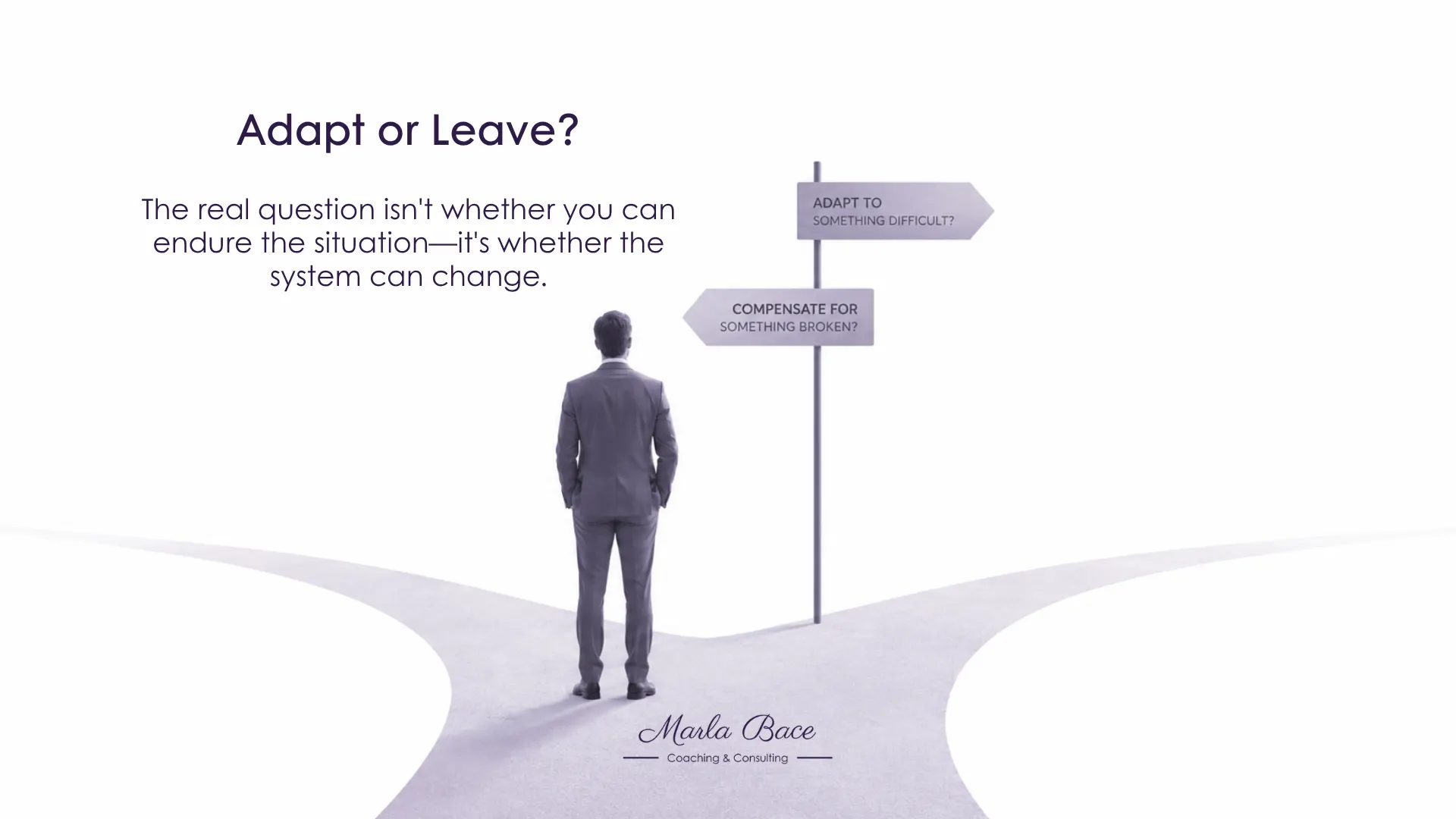
The question becomes: Am I adapting to a difficult but responsive environment, or am I continually compensating for a system that leaves no room for the adaptation to succeed?
What Should You Do When a Difficult Work Situation Won’t Change?
The 15-Minute Pre-Meeting Playbook can help you prepare for a conversation that tests the situation. It helps you clarify the outcome you need, the pressures shaping the other person’s response, and the smallest useful next step that would demonstrate whether the environment can move.
Download the 15-Minute Pre-Meeting Playbook to prepare for a conversation about workload, priorities, boundaries, role expectations, or the sustainability of the current operating pattern.
When you are too close to the situation to distinguish a difficult season from a system that cannot support change, book a Strategic Leadership Conversation. We will look at what the environment has already shown, what your efforts have and have not changed, and whether there is a credible path toward a different operating reality.
Frequently Asked Questions
A temporarily difficult situation usually responds to clear diagnosis, changed priorities, stronger boundaries, or a revised operating agreement. A structural problem persists because the organization’s pace, incentives, or power dynamics continually recreate the same strain.
Persistent exhaustion is important evidence, but it is not the only question. Examine whether the organization can reduce the causes of the exhaustion and whether you have enough space to recover and operate differently. If every attempt at change returns you to the same pattern, the problem may be structural.
Better communication can improve understanding and reduce avoidable friction. It cannot, by itself, fix an environment that has no time for reflection, no authority to change priorities, or no willingness to alter the operating pattern.
Test whether the issue can be discussed fully, whether priorities can be reduced or sequenced, whether boundaries are respected, and whether agreements lead to observable changes in behavior.
Capable professionals are accustomed to solving problems through effort and adaptation. Searching for another tactic can feel safer than accepting that the environment may not be able to support the change you are trying to create.