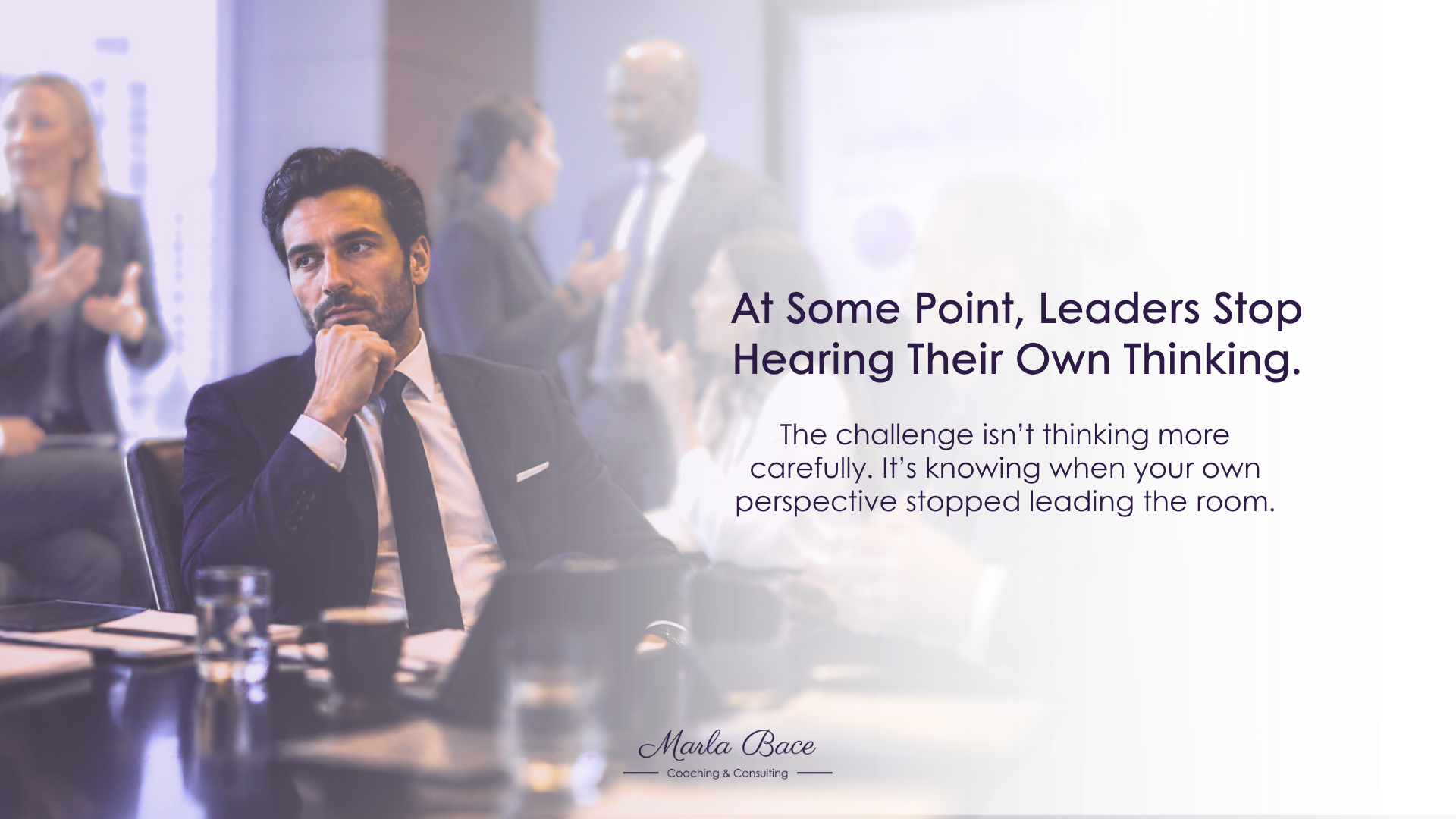
There’s a point in leadership where you stop noticing something important — your own perspective.
Not because you don’t care.
Because you’ve gotten very good at reading the room.
You know how decisions will land.
You can anticipate reactions.
You can feel where resistance might show up before anyone says a word.
That’s part of what makes you effective.
But over time, something starts to blur.
You stop asking:
What do I actually think about this?
When Leadership Judgment Shifts Outward
At earlier stages, your thinking is more direct.
You see something.
You react to it.
You form an opinion.
As responsibility grows, that changes.
You start holding:
- multiple perspectives
- competing priorities
- political dynamics
- downstream implications
And your thinking adapts.
You don’t just process the issue.
You process how everyone else will experience the issue.
That’s where the shift begins.
Not away from intelligence.
Away from ownership of thought.
Research on group decision-making shows that as leaders become more attuned to group dynamics, independent judgment can quietly narrow—what feels like thoughtful alignment can actually suppress individual perspective.
If this is already familiar, you don’t need more content—you need to stay in this level of thinking.
→ Join Presence is Power
How Leadership Judgment Gets Diluted
It doesn’t happen in a single moment.
It happens in layers.
You adjust your language to keep things moving.
You soften your position to maintain alignment.
You leave space so others feel heard.
All of which are leadership skills.
Until they start replacing something more fundamental.
Clarity.
The Director-Level Shift Most People Miss
This came up directly in a recent session with a client stepping into a Director role.
Her instinct was to stay close to the work.
To contribute.
To refine.
To help shape outcomes in real time.
Which had always made her successful.
But at that level, something else was required.
Not more input.
Clearer position.
The question wasn’t:
How do I help this move forward?
It was:
What is my perspective—and am I willing to hold it?
Why Strong Leadership Judgment Feels Risky
Because having an opinion at that level carries weight.
It influences direction.
It affects people.
It creates consequences.
So most leaders compensate.
They:
- keep options open longer than necessary
- frame ideas as questions instead of positions
- defer until alignment feels complete
Not because they don’t have a point of view.
Because committing to it feels heavier than managing around it.
The Cost of Weakened Leadership Judgment
This is where things start to slow down.
Decisions take longer.
Meetings feel productive, but don’t move Even when it’s subtle.
Conversations circle instead of land.
Not because the team isn’t capable.
Because the leader hasn’t made a call.
Even when it’s subtle.
Even when it’s unspoken.
The absence of a clear opinion creates more work than the presence of one.
What Reclaiming It Actually Requires
This is the part most people underestimate.
Reclaiming your opinion isn’t about:
- being more confident
- speaking more forcefully
- asserting yourself
It’s quieter than that.
It’s being willing to:
- sit with your own thinking before testing it against everyone else’s
- recognize when you’re shaping your view to fit the room
- notice when you’re avoiding a position because of how it will land
That’s where it starts.
Why Most Leaders Avoid It
Not because they don’t know how.
Because they’ve been rewarded for doing the opposite.
For:
- being collaborative
- being inclusive
- being thoughtful
All of which matter.
But none of them replace judgment.
And at some point, leadership requires:
- less processing
- more positioning
What Changes When You Do
The shift isn’t loud.
But it’s immediate.
Conversations move faster.
Decisions land more cleanly.
Teams stop circling and start executing.
Not because everything is certain.
Because something is clear.
The Question That Brings It Back
Most leaders don’t ask this directly.
But it’s the one that matters:
If I weren’t managing the reaction to this, what would I actually say?
That question cuts through:
- positioning
- hesitation
- over-processing
And brings you back to something simpler.
Your own thinking.
Where This Leaves You
If you’ve noticed:
- you’re speaking more carefully than clearly
- you’re asking more than you’re stating
- you’re waiting for alignment before taking a position
You’re not off track.
You’re adapting.
But there’s a point where adaptation starts to dilute judgment.
And that’s where the shift back needs to happen.
A Final Reflection
The leaders who create movement aren’t the ones with the most input.
They’re the ones who are willing to hold a point of view.
Even when it’s not fully agreed on.
Even when it changes direction.
Even when it creates tension.
Because they understand:
Presence isn’t just how you show up.
It’s whether your thinking is actually present in the room.
If This Is Something You’re Navigating
This is where most leaders don’t need more feedback.
They need space to hear their own thinking again.
That’s often the difference between:
→ managing the conversation
→ and actually leading it
If Your Thinking Has Started To Sound More Filtered Than Clear
At senior levels, many leaders stop losing capability.
They start losing access to their own perspective.
A Clarity Review creates space to examine where over-processing, alignment management, or constant external awareness may be diluting leadership judgment and slowing clear decision-making.
A short, focused session to help you see what’s yours to carry—and what isn’t.
Common Questions Leaders Ask at This Stage
Leadership judgment is the ability to form and hold a clear perspective while balancing complexity, competing priorities, and organizational dynamics. It supports decision-making, direction, and strategic clarity.
As responsibility increases, leaders often become highly attuned to group dynamics, reactions, and alignment. Over time, this can weaken independent judgment and reduce ownership of thought.
Alignment becomes problematic when leaders shape their perspective around group comfort rather than independent thinking. Excessive focus on consensus can dilute judgment and slow decision-making.
Leadership decisions often slow down when leaders over-process perspectives, delay taking a position, or prioritize managing reactions over clear direction.
Leaders reclaim their perspective by creating space to think independently before filtering ideas through external reactions, alignment, or political considerations.