Executive Takeaway
Being read as tactical often has less to do with capability than with how strategic judgment is signaled. It is a signaling problem. Many senior managers, directors, and high-capacity leaders are already thinking at the level of risk, trade-offs, timing, authority, and consequence. The issue is that the room only sees the output, not the judgment behind it. Strategic discernment helps you identify where your thinking is being flattened into execution, and accurate authority helps you change how your contribution lands before the organization keeps rewarding your usefulness while delaying your influence.
Why are strategic leaders often seen as tactical?
Strategic leaders are often perceived as tactical because colleagues see execution rather than the judgment behind it. When risk assessment, trade-offs, and decision-making remain invisible, organisations tend to reward delivery instead of strategic thinking.
In This Article
- Why being read as tactical is often a signaling problem, not a capability problem
- Who this article is really for
- Why the gap exists between how you operate and how you are being read
- Which communication patterns trigger tactical categorization
- What strategic-level communication actually sounds like
- How to make your strategic judgment visible without performing a different version of yourself
- How situational intelligence helps you read the room before you reposition your message
- What changes when the reading gap closes
- What the misread costs in advancement, authority, credibility, and decision weight
- How Marla’s advisory lens helps leaders close the gap between contribution and recognition
- How the 15-minute playbook and 30-minute strategy session support a more accurate read
- Frequently asked questions about being seen as strategic at work
Executive Summary
- What this article addresses: The gap between the level at which a senior professional is actually thinking and the level at which the organization is reading their contribution.
- What is often happening: The leader is making strategic judgments, but communicating through task, effort, output, or implementation language that allows others to categorize them as operational or technical.
- Why this matters: A tactical read can stall advancement, weaken promotion narratives, keep decision rights out of reach, and make a high-capacity leader indispensable to execution but peripheral to authority.
- What strategic discernment helps you do: Read which parts of the room need context, consequence, risk, timing, or authority before they can recognize the strategic level of your contribution.
- What self-awareness helps you do: Notice where you default to proving, explaining, rescuing, or over-delivering instead of making the judgment behind the work visible.
- What accurate authority helps restore: The alignment between the level of judgment you are bringing and the level of weight the room assigns to it.
- What to do next: Shift from showing the work to signaling the judgment, so the organization can read you at the level where you are actually operating.
Why Are You Being Read as Tactical When You’re Operating at a Strategic Level?
Being read as tactical when you are operating strategically is not a communication problem. It is a signaling problem.
Most capable senior professionals assume that if the thinking is strong enough, the room will eventually recognize the level of the work. They believe better execution, cleaner communication, or more visible results will translate into strategic recognition.
What actually changes outcomes is not more proof. It is making the strategic judgment behind the work legible to the people who assign authority, credibility, and opportunity.
The gap is rarely in the quality of your thinking. It is in which parts of your thinking you make visible, to whom, and when.
This distinction matters because many high-capacity leaders are already operating at a strategic level. They see risk before it becomes visible.
Long before the room names them, they understand the trade-offs.
They also anticipate downstream consequences.
Just as importantly, they know which stakeholder will resist, which detail will become political, and which decision is being delayed because no one wants to own what it will change.
But if the room only sees the task completed, the update delivered, the issue solved, or the project moved forward, it may not see the strategic discernment underneath the work.
That is how a leader becomes trusted with complexity but not recognized for strategy. Useful, but not elevated. Relied on, but not repositioned. Essential to the outcome, but absent from the authority that shapes it. This is how high-capacity leaders become indispensable to execution while remaining under-recognized in authority.
Being read as tactical is one of the most common frustrations experienced by senior leaders who are already operating strategically.
Signs You’re Being Read as Tactical
- You’re asked to execute but not shape strategy.
- People praise reliability more than judgment.
- Others present your ideas as strategic.
- You’re involved after decisions have already been made.
- Promotions keep being delayed despite strong results.
Who Is This Article Really For if You’re Being Read as Tactical?
This is not for someone trying to learn basic professionalism or become more polished in meetings.
This is for the senior manager who is already thinking beyond their lane, but is still being treated like the person who makes the work happen rather than the person who shapes what should happen next.
Perhaps you’re the director whose recommendations are grounded in risk, timing, market realities, stakeholder behavior, and organizational consequences, yet whose contribution is still summarized as execution.
Or you’re the high-capacity operator who gets pulled into the hard work, the messy work, the rescue work, and the stakeholder cleanup, but not always into the earlier room where priorities, trade-offs, budget, or authority are decided.
You may even be the executive whose thinking is strategic, but whose language still gives too much room to be heard as tactical.
This buyer is not asking for generic advice on how to sound more strategic. They are asking why their level is not being accurately read when the substance is already there.
If you have ever watched someone repeat your idea with less context and more authority, then seen the room respond differently, this is the problem I am naming.
If you have ever watched the room praise your reliability while overlooking your judgment, this is the gap I am naming.
Why Are You Being Read as Tactical When You’re Already Thinking Strategically?
The first reason is that strategic thinking is often invisible while it is happening.
By the time your work reaches the room, you may have already filtered risk, weighed stakeholder reactions, adjusted timing, anticipated objections, and made ten judgment calls that no one saw. The final recommendation looks simple because you already did the strategic work before presenting it.
That is one of the traps. The better you are, the cleaner the output looks. And clean output can be misread as simple execution.
The second reason is that recognition usually lags behind the level. You may begin operating strategically before the organization has changed its story about who you are. The room may still be reading you through an old category: dependable, responsive, technical, operational, helpful, good with details, strong executor.
Those labels sound positive. They can also become ceilings.
The third reason is that most performance systems reward visible output more easily than invisible judgment. Completed projects are easier to measure than discernment quality. Responsiveness is easier to praise than enterprise-level pattern recognition. Activity is easier to notice than strategic restraint.
So the leader keeps producing value, but the organization keeps categorizing the value at the wrong level.
This is where advancement can stall. Not because the leader lacks strategy, but because the room has not been given enough strategic signals to update its read.
The issue is not whether you are thinking strategically. The issue is whether the room has enough evidence to categorize you that way before old assumptions take over.
Which Communication Patterns Cause You to Be Read as Tactical?
The first pattern is to lead with the solution rather than the frame.
When you open with what should be done, the room may hear you as solving a task. When you open with why the issue matters, what is at risk, what trade-off is emerging, or what consequences the organization is facing, the room is more likely to hear strategic judgment.
The goal is not simply to communicate better. It is to stop being read as tactical when your thinking is already strategic.
The second pattern is to explain execution rather than naming implications.
A tactical update says, ‘Here is what we completed.’ A strategic update says, ‘Here is what these changes expose, and what decision it now requires.’ Same work. Different signal.
The third pattern is making effort visible instead of making judgment visible.
Many high-capacity leaders over-explain because they want the room to understand the rigor behind the work. But too much process detail can make strategic thinking sound operational. The more you explain the steps, the easier it becomes for the room to miss the level of judgment behind them.
The fourth pattern is rescuing the room too quickly.
When you constantly absorb ambiguity, clean up confusion, and make difficult work easier for others to consume, you may become known as indispensable. But indispensable is not the same as strategic. Sometimes the room only recognizes your value as relief, not authority.
This is one of the quiet costs of over-functioning: the organization may depend on your judgment while still treating you as an executor.
When judgment stays hidden, and labor stays visible, the room almost always assigns the lower-level read.
What Does Strategic-Level Communication Actually Sound Like?
Strategic-level communication makes the judgment visible before the content.
It does not simply report what happened. It frames what the situation means.
Instead of saying, ‘We finished the analysis, and the recommendation is to move forward,’ strategic communication sounds more like: ‘The analysis points to moving forward, but the more important issue is timing. If we wait another quarter, the operational risk becomes a credibility issue with the client.’
Instead of saying, ‘The team is behind on the project,’ strategic communication sounds more like: ‘The delay is not just a project management issue. It reveals a decision-rights problem. The team is executing against priorities that are still being negotiated above them.’
Instead of saying, ‘I can take care of that,’ strategic communication sounds more like: ‘I can move this forward, but before I do, we need to decide who owns the trade-off. Otherwise, I will be solving the symptom while the same issue recreates itself.’
Instead of saying, ‘Here is the update,’ strategic communication sounds more like: ‘Here is the update, what it signals, and the decision it creates.’
That difference is not cosmetic. It changes how the room categorizes you.
When you lead with work, you are easier to read as tactical. When you lead with consequences, trade-offs, timing, risk, and decision quality, you give the room the signals it needs to recognize the strategic level.
What Does This Look Like in a Real Room?
A director presents a recommendation in a leadership meeting. The work is strong. The data is right. The next steps are clear. They explain what the team found, what has been completed, and what needs to happen next.
The room thanks them. The recommendation is treated as useful input. A senior leader asks a few implementation questions. Someone else says, ‘This is helpful.’ The meeting moves on.
Nothing about the exchange sounds negative. That is why it is so easy to miss.
But the director has just been read one level below where they were operating. Their strategic judgment was incorporated into the project update.
A different signal would have changed the room: ‘Before I walk through the recommendation, I want to name the strategic issue this surfaced. We are treating this as an implementation decision, but it is really a prioritization decision. If we move forward without resolving ownership, we will create downstream execution drag and the team will absorb the confusion.’
That statement does not make the leader louder. It makes the level of their thinking harder to miss.
This is the shift. Not more polish. Not more performance. A clearer signal of the judgment already operating underneath the work. The leader did not become more strategic in that moment. They became more legible at the strategic level they were already operating from.
How Do Situational Intelligence and Self-Awareness Help You Change the Signal?
You cannot change how the room reads you unless you first understand what the room is currently reading.
Self-awareness helps you notice your own default. Do you prove through detail?
Or soften the strategic point so it doesn’t seem difficult?
Perhaps you move too quickly into helpfulness.
Many capable leaders also take pride in making complex things easy while accidentally hiding the judgment that made them easy.
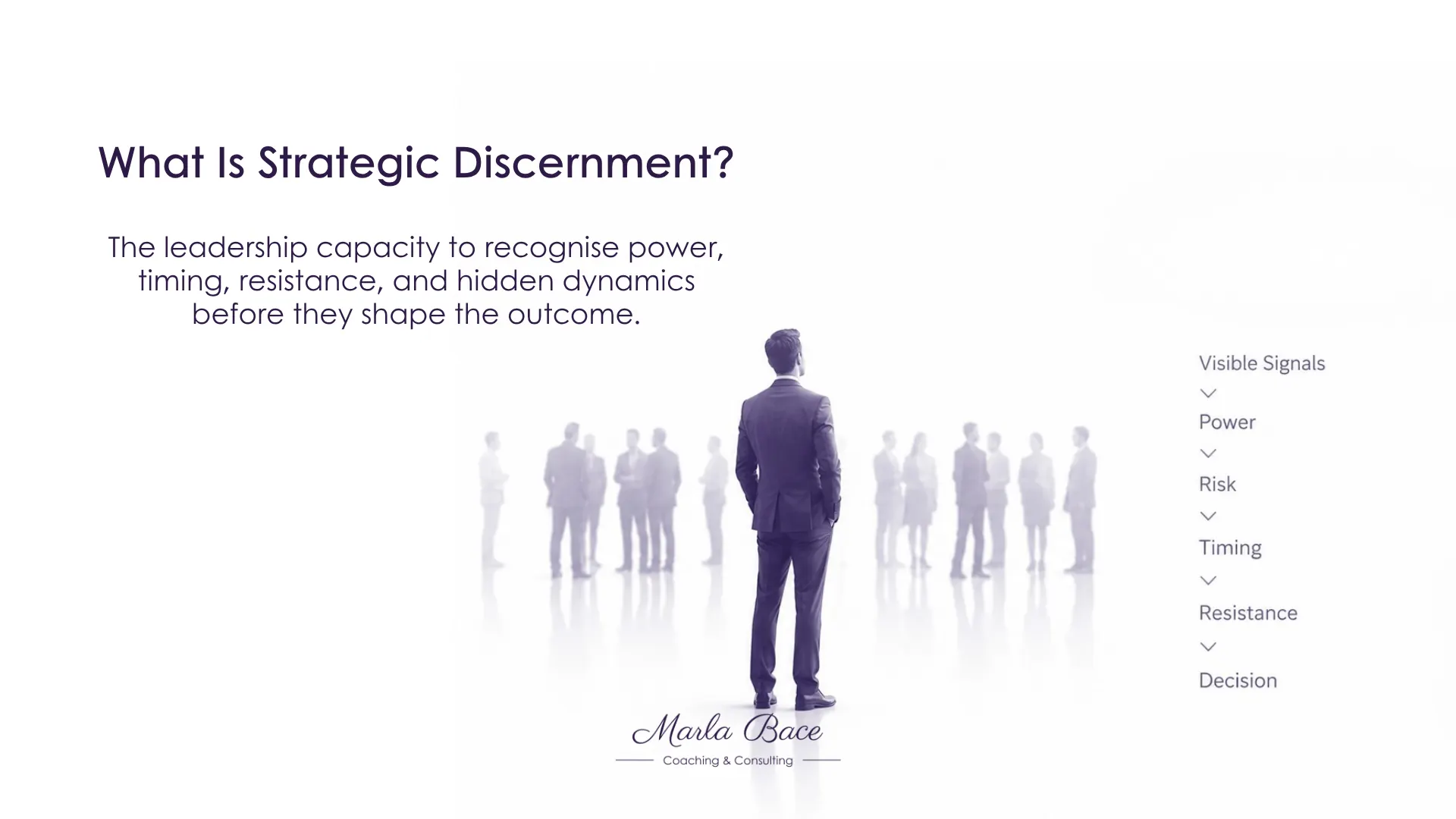
Situational intelligence helps you read the environment. What does this room reward? Who is allowed to speak strategically? What topics make people defensive? Which leaders respond to risk, which respond to growth, and which respond only when consequences are named?
Without self-awareness, you may keep repeating a communication pattern that under-signals your level. Without situational intelligence, you may signal the right thing to the wrong person, at the wrong time, in the wrong language.
Once you stop being read as tactical, people begin asking for your judgment before they ask for your execution.
This is where my advisory lens is different from generic communication coaching. I am not simply asking whether you were clear. I am reading the room underneath the exchange: how your contribution was categorized, which authority cues were missing, where the room flattened judgment into execution, and what signal would have made the strategic level harder to ignore. That difference matters because the wrong advice can make a capable leader communicate harder when what they actually need is a more accurate read of how authority is being assigned in the room.
The work is not to become someone else. The work is to stop letting the room mistake your judgment for task completion.
How Do You Shift Your Signaling Without Performing a Different Version of Yourself?
This is not about becoming more political, more theatrical, or more self-promotional.
It is about making the strategic thinking you are already doing legible to the people who need to recognize it.
You do that by moving the frame earlier. Start by naming the issue before the update.
Next, identify the trade-off before presenting the solution.
Then explain the consequence before offering the recommendation.
Finally, make it clear why the detail matters.
You also do it by reducing how much labor detail you narrate. Not by listing every step, but by naming the judgment calls that shaped the work: what you ruled out, what risk you weighed, what timing issue changed the recommendation, what stakeholder reality affected the path forward.
You do it by asking questions that signal level: ‘What decision are we actually making here?’ ‘Who needs to own the consequence of this trade-off?’ ‘Are we solving the execution issue, or are we avoiding the prioritization issue underneath it?’
And you do it by refusing to let expanded responsibility remain disconnected from authority. If you are being asked to carry strategic risk, you need access to the strategic conversation.
That is accurate authority in practice: your language, positioning, and decision rights begin to match the level of judgment you are already bringing.
What Changes When You Stop Being Read as Tactical?
When the reading gap closes, the room begins to invite you differently.
Before decisions harden, people begin asking for your perspective.
Rather than being brought in only to execute, you are invited to shape.
Instead of simply solving problems, you are trusted to identify which problem matters.
The conversations change. Instead of being asked, ‘Can you take care of this?’ you begin hearing, ‘How are you reading this?’ ‘What are we missing?’ ‘Where do you think the risk is?’ ‘What would you do before this becomes more expensive?’
That shift matters because senior-level opportunities often come through consideration before they come through title. If the room does not consider you at the strategic layer, it is harder to build a promotion narrative around strategic leadership.
This is why being read correctly is not vanity. It affects advancement, authority, visibility, succession, budget influence, and decision weight.
It also changes the internal experience of leadership.You stop trying to earn recognition by carrying more.
Instead, you stop translating your own judgment into a smaller language so it feels safer for the room.
Eventually, usefulness and influence stop being treated as the same thing.
When the room reads you correctly, you do not have to overperform to be taken seriously. Your judgment starts arriving at the level it belongs.
What Does Being Read as Tactical Cost Your Career?
Being misread as tactical is not a minor perception issue. It can become a career architecture problem.
Over time, a punishing loop can emerge: the more strategic judgment you bring, the more invisible that judgment becomes because the organization only rewards the output it made possible.
As a result, advancement can stall because your results are visible, but your strategic judgment is not.
Your promotion case may also weaken because the organization has examples of your reliability, but fewer examples of your enterprise-level leadership.
Instead, you remain in the role of fixer, translator, or executor while others are positioned as decision-makers.
That is the trap. The more the room misreads you, the more you may adjust yourself in ways that reinforce the wrong read.
Over time, being read as tactical can quietly reshape promotion decisions and leadership opportunities.
This can drain self-trust. You know you are operating strategically, but the room keeps handing you tactical mirrors. Eventually, you may start asking whether you are the problem, when the more accurate question is whether your signals, audience, timing, and authority cues align with the level of your work.
You cannot build the next level on a misread. You have to correct the signal.
How Does Marla’s Advisory Lens Help Close the Reading Gap?
My work is not about teaching capable leaders to sound more impressive in meetings.
It is about reading the actual room and identifying why the leader’s contribution is being categorized below its real level.
I listen for the hidden structure of the exchange: where the leader is leading with labor instead of judgment, where the room is benefiting from their usefulness, where authority is being protected, where the strategic point is arriving too late, and where the leader is being asked to carry complexity without being considered at the level that complexity requires.
Then the work becomes practical. We look at language, timing, audience, framing, decision rights, and how to make the leader’s strategic judgment more legible without turning them into a performer.
The value is not generic encouragement. It is a more accurate read of what is happening between contribution and recognition. I am not helping you manufacture a more strategic persona. I am helping you identify where your real level is being misread, what the room is rewarding instead, and how to close that gap without overperforming your way into more misunderstanding.
Because sometimes the next move is not to communicate more. It is to signal differently.
Need a More Accurate Read on the Room?
Start with the 15-minute playbook if you need to distinguish between a communication issue and a room-level signaling problem before you spend another quarter proving the wrong thing.
The playbook helps you slow the situation down and read it more cleanly: what the room is actually rewarding, where your judgment is being flattened into execution, which authority cues are missing, and what signal would help others read your level more accurately.
Correcting the signal is how you stop being read as tactical and start being recognised for the strategic judgment you already bring.
If the pattern runs deeper, the next step is a 30-minute strategy session with me. We look at the actual room, not the abstract leadership issue: who has power, how your contribution is being categorized, what is being protected, and what move would restore more accurate authority.
The goal is not generic encouragement. The goal is to read precisely to change your next move.
Key Takeaways
- Strategic thinking is often invisible.
- Execution alone doesn’t communicate judgment.
- Strategic signaling shapes leadership perception.
- Accurate authority comes from making decision quality visible.
- Strategic discernment helps leaders close the perception gap.
Frequently Asked Questions
People may perceive you as tactical when the strategic thinking behind your work is not visible. If you lead with tasks, updates, solutions, or execution detail, the room may miss the judgment, risk assessment, timing, and consequence analysis underneath the work.
To be recognized as a strategic thinker, make the judgment behind your work visible. Name the context, implication, trade-off, risk, timing, or decision the work creates. Strategic recognition increases when people can see not only what you did, but how you are reading the business. Recognition changes when people can see not only that you did the work, but that you were reading risk, trade-offs, timing, and business consequences at a higher level than the output alone reveals.
Strategic communication frames meaning before content. It moves from ‘Here is what I did’ to ‘Here is what this means, why it matters, what it changes, and what decision it now requires.’ It helps the room understand the level of judgment behind the recommendation.
You may be delivering at the next level while still being read through a current-level category. If your results are visible but your strategic judgment, decision quality, and authority cues are not, the organization may rely on your work without updating its view of your level.